
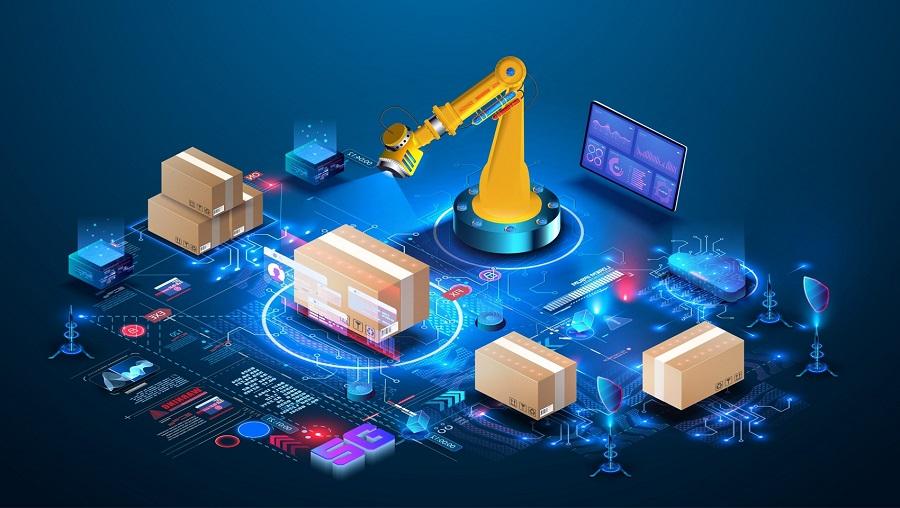
The convergence of advanced analytics and global commerce has forged the modern Artificial Intelligence in Supply Chain Industry, a sector dedicated to transforming traditional, linear supply chains into intelligent, autonomous, and resilient digital ecosystems. This industry provides the software, hardware, and services needed to move beyond reactive decision-making towards a predictive and prescriptive operational model. By leveraging technologies like machine learning, computer vision, and natural language processing, the industry's core mission is to solve long-standing challenges such as demand volatility, inventory imbalances, logistical inefficiencies, and unforeseen disruptions. It aims to create self-learning systems that can anticipate problems, optimize processes, and adapt to changing conditions in real-time, ultimately delivering unprecedented levels of efficiency, visibility, and agility. This transition is no longer a luxury but a competitive necessity for any business involved in the movement of goods in the modern economy.
The industry's ecosystem is a dynamic interplay of diverse players. At the foundational level are the major cloud and AI platform providers like Amazon Web Services (AWS), Google Cloud, and Microsoft Azure. They supply the scalable computing power and fundamental machine learning services that underpin many solutions. The next layer consists of established enterprise software giants, such as SAP, Oracle, and Blue Yonder, who are aggressively integrating AI capabilities into their existing, deeply entrenched Supply Chain Management (SCM) and Enterprise Resource Planning (ERP) suites. A third, and highly innovative, segment is composed of specialized AI-native startups. These agile companies often focus on solving a specific, high-value problem, such as real-time freight visibility (e.g., project44, FourKites) or autonomous warehouse robotics, challenging the incumbents with cutting-edge technology and a laser focus on user experience.
The value chain within this industry is a complete data-to-decision lifecycle. It begins with data ingestion, where information is collected from a multitude of sources—IoT sensors on shipping containers, ERP systems, weather feeds, social media trends, and GPS data from trucks. This vast and varied dataset is then cleansed and processed by AI platforms. Machine learning models analyze this data to generate insights, such as a more accurate demand forecast or a predicted delay in a shipment. These insights are then translated into actionable recommendations or, in more advanced systems, trigger automated actions. For instance, the system might automatically re-route a truck to avoid traffic or adjust inventory levels at a warehouse in response to a predicted demand spike. This continuous loop of data, analysis, and action is the essence of an intelligent supply chain.
The offerings of the industry are not limited to software alone; they form a comprehensive triad of software, hardware, and services. The software component, from AI-powered planning tools to warehouse management systems, is the "brain" of the operation. The hardware component acts as the "senses and limbs," including IoT sensors for data collection, computer vision cameras for inspections, and autonomous mobile robots (AMRs) for warehouse fulfillment. The services component is the connective tissue, encompassing strategic consulting to design AI roadmaps, system integration to connect disparate data sources, and data science expertise to build and train custom machine learning models. The successful implementation of AI in the supply chain requires a harmonious integration of all three components to create a truly intelligent and responsive operational network.
Explore More Like This in Our Regional Reports:
US Security Software Telecom Market Share

 English
 Arabic
 French
 Spanish
 Portuguese
 Deutsch
 Turkish
 Dutch
Dutch
 Italiano
 Russian
 Romaian
 Portuguese (Brazil)