
EU Search Data Sharing Risks
A draft EU measure to mandate search data sharing sparks warnings of unintended surveillance capabilities.
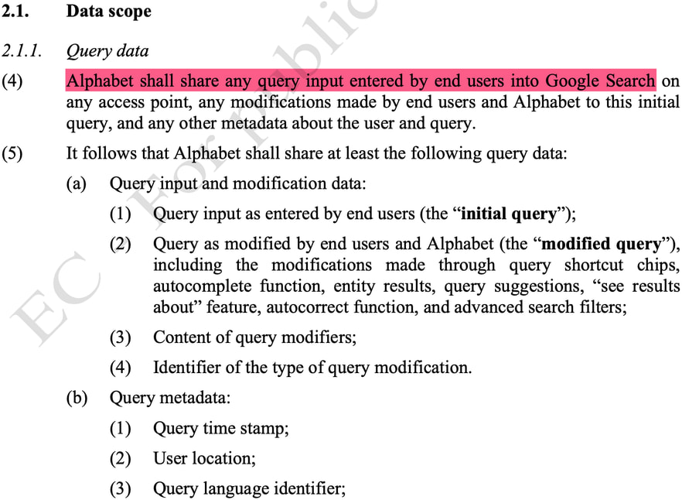
The proposal under the Digital Markets Act would compel Google to provide third parties with a real-time API feed of European search activity.
This feed could contain comprehensive query details, timestamps, location indicators, and nuanced user interaction signals.
Although designed to strip direct identifiers, experts contend the data's richness presents substantial re-identification dangers.
Cybersecurity researcher Lukasz Olejnik identifies critical flaws in the proposed data sanitization mechanisms.
He argues these shortcomings could transform the pro-competitive measure into a tool for mass data exploitation.
The warnings highlight a tension between fostering market competition and safeguarding fundamental privacy rights.
The outcome could set a precedent with far-reaching implications for data governance and digital security.
The EU's digital competition push carries a hidden surveillance risk.
Its new rule for gatekeepers like Google hinges on a flawed anonymization model.
Query fragments like names or keywords enter an "allowlist" for data sharing.
They qualify after appearing in searches by 50 signed-in users over 13 months.
Once approved, these terms can be included in shared datasets for five years.
The critical flaw is the focus on isolated components, not full queries.
A uniquely sensitive search built from common, approved terms could be exposed.
This system, aimed at opening markets, might instead enable large-scale profiling.
The unintended consequence is a potential blueprint for institutional surveillance.
Privacy advocates and security researchers have raised serious concerns about a proposed European Union regulation that would require Google to share user search data with third parties. While the measure is framed as a means to promote competition, critics warn it could open the door to widespread surveillance and privacy violations.
At the heart of the concern is a mechanism that would expose aggregated search queries, clicked links, and interaction timing data through a shared data feed. Security analyst Lukasz Olejnik has outlined several ways this system could be exploited, arguing that the proposal contains fundamental design flaws that make it susceptible to abuse.
One alarming vulnerability involves the manipulation of so-called allowlists — the approved set of search terms included in the shared data feed. Bad actors could deliberately flood the system with repeated searches across multiple accounts, artificially elevating specific terms until they qualify for inclusion. Once a term is on the allowlist, it can be used to continuously monitor queries related to particular individuals, organizations, or sensitive subjects over long periods of time.
Beyond the allowlist manipulation, there is a significant risk that the shared data could be cross-referenced with outside information sources. The feed includes not only search terms but also clicked URLs and generalized timing details. This combination means that anyone with access to website analytics platforms or embedded tracking scripts could potentially match entries from the search feed against their own visitor records. Even without direct identifiers, this process could allow analysts to reconstruct individual browsing and search histories — effectively undoing whatever anonymization measures were originally applied.
Geographic data introduces yet another layer of risk. Although location information in the feed is deliberately coarsened, grouping users into areas of at least three square kilometers containing a minimum of one thousand people, these zones can still map closely onto identifiable real-world spaces. Specific neighborhoods, university campuses, hospital districts, or government office complexes could fall within a single geographic bucket. Sustained observation of search patterns tied to these areas could gradually reveal sensitive behavioral trends associated with the people who live or work there, raising concerns about monitoring of activists, patients, employees, and public officials alike.
Concerns Over Data Privacy Regulation
A cybersecurity expert has raised serious concerns about a recently proposed regulation, characterizing it as one of the most alarming threats to data privacy that Europe has faced in a long time.
According to the researcher, the framework being put forward carries an enormous potential for exposing sensitive user information on a wide scale, a risk that has not been adequately acknowledged by its proponents.
Central to the criticism is the over-reliance on procedural measures as a means of protection. The researcher argues that simply putting administrative rules and bureaucratic oversight in place is far from enough when it comes to safeguarding personal data at this level. What is truly needed, the expert contends, are strong and enforceable technical mechanisms built directly into the system itself, rather than policies that depend on human compliance and institutional goodwill.
Furthermore, the proposal has drawn sharp criticism for its underlying assumptions about anonymization and access frequency. The researcher takes direct aim at the notion that limiting how often data can be accessed, combined with partial anonymization techniques, would be sufficient barriers against potential misuse. These measures, in the expert's view, offer only a superficial layer of protection and could easily be circumvented by sophisticated actors with the intent and resources to do so.
The overall message from the researcher is clear: the current design of this proposal leaves too much room for abuse, and without a fundamental rethinking of its technical safeguards, it risks becoming a vehicle for large-scale surveillance rather than a tool that serves the public interest.
Why People Need VPN Services to Unblock Porn
People rely on VPN services to unblock porn primarily because many countries enforce strict geo-restrictions and censorship laws that prevent access to adult content, making a VPN an essential tool for bypassing these digital barriers by masking the user's IP address and rerouting their connection through servers in unrestricted regions. Beyond circumventing geographical limitations, VPNs also provide a secure and encrypted browsing experience, shielding users from ISP monitoring, potential bandwidth throttling, and cybersecurity threats — especially when using public Wi-Fi networks. In essence, unblock porn refers to the process of gaining unrestricted access to adult content through privacy-focused tools like VPNs, which empower users to browse freely while maintaining their anonymity and personal data security.
Why Choose SafeShell VPN to Access Adult Content
If you are looking to access region-restricted adult content and want to unblock porn sites without compromising your privacy, SafeShell VPN might be exactly what you need. Unlike conventional browsing methods that leave your online activities exposed, SafeShell VPN provides a comprehensive solution that combines anonymity, speed, and unrestricted access. By routing your connection through a vast network of global servers, it allows you to bypass geographical barriers effortlessly, giving you the freedom to explore content that would otherwise be unavailable in your location.
SafeShell VPN distinguishes itself from competitors through a series of impressive features designed to elevate your browsing experience. Its proprietary ShellGuard protocol delivers military-grade encryption, ensuring that your online sessions remain completely invisible to ISPs, network administrators, and other third parties. Furthermore, the platform's unique App Mode functionality enables users to simultaneously access content from multiple regions, eliminating the inconvenience of constantly switching between servers. This, combined with its blazing-fast connection speeds, means you can stream high-definition content without any frustrating buffering or quality loss.
What truly sets SafeShell VPN apart as the go-to tool to unblock porn sites is its remarkable versatility and user-friendly approach. Supporting up to five devices at once across a wide range of platforms, including Windows, macOS, iOS, Android, and even Apple Vision Pro, SafeShell VPN guarantees that every device you own benefits from the same robust protection. Whether you are at home or on the go, SafeShell VPN remains a reliable companion that prioritizes both your security and your right to unrestricted internet access.
How to Use SafeShell VPN to Unlock Porn Sites
To begin accessing adult content from any region using SafeShell VPN, you will first need to visit the official SafeShell VPN website and select a subscription plan that suits your requirements. Once you have completed the registration and payment process, proceed to download and install the SafeShell VPN application on your preferred device, whether it be a smartphone, tablet, or computer. After installation, launch the app and navigate to the settings to activate App Mode, which enhances your ability to bypass regional restrictions and unlocks a broader range of content. This mode ensures that your connection is optimized for streaming and browsing adult platforms from various parts of the world.
With SafeShell VPN properly configured, the next step is to browse through the available global server network and select a server located in the region whose content you wish to access. For example, if you want to view adult material available only in certain countries, simply connect to a server based in that specific location. Once connected, SafeShell VPN will mask your real IP address, replacing it with one corresponding to your chosen server location, effectively making it appear as though you are browsing from that region. You can then open your preferred adult website and enjoy unrestricted, private access without worrying about geographical limitations or privacy concerns, as SafeShell VPN keeps your online identity fully protected throughout your browsing session.

 English
 Arabic
 French
 Spanish
 Portuguese
 Deutsch
 Turkish
 Dutch
Dutch
 Russian
 Romaian
 Portuguese (Brazil)
 Greek
Greek