
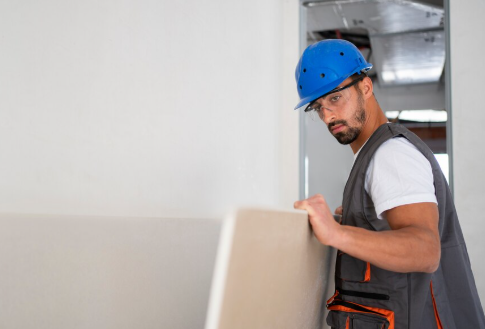
If you have ever walked into a room and noticed wavy lines, visible seams, or rough patches on the walls, you already know how much drywall finishing matters. Even the best drywall installation can look sloppy if taping and mudding are not done right. This stage is what turns bare drywall into a smooth, clean surface that is ready for paint and texture. When handled by professionals, taping and mudding do more than just hide seams. They give your walls strength, durability, and a finished look that lasts.
Let’s break down how this process works and why it plays such a big role in how your home looks and feels.
What Taping and Mudding Really Do
Drywall panels are installed in large sheets, and where they meet, seams are created. There are also screw heads holding the boards in place. Taping and mudding cover these seams and fasteners so the wall looks like one continuous surface.
Drywall tape is placed over every joint. Joint compound, often called mud, is then applied over the tape and screws. This fills gaps, smooths edges, and locks everything together. Once dry, it is sanded flat. This process is repeated in layers until the wall looks even and solid.
When drywall taping and mudding is done properly, you cannot tell where one sheet ends and the next begins. That is the goal of professional drywall finishing.
Why This Step Affects How Your Walls Look
Taping and mudding control how light moves across a wall. Any ridge, dip, or rough spot will catch shadows and make a surface look uneven. This is especially noticeable once paint goes on.
Professionals apply compound in wide, thin layers so the surface stays flat. Each coat is feathered out beyond the seam to blend it into the wall. This keeps edges from showing later. The end result is a wall that reflects light evenly and looks smooth from every angle.
The Role of Experience in Clean Finishes
Taping and mudding look simple, but they take skill. Knowing how thick to apply the compound, how long to wait before sanding, and how wide to feather each layer all come with experience.
Too much mud creates bumps. Too little leaves lines. Sand too early and the surface tears. Sand too late and it becomes hard and uneven. Professional finishers read the wall as they work. They adjust pressure, tools, and timing to keep the surface clean and level.
This is why experienced drywall teams can get better results in less time.
How Multiple Coats Make a Difference
One coat of mud is never enough. A professional finish uses at least three layers. The first embeds the tape and fills deep gaps. The second builds the surface. The third smooths and blends everything into the wall.
Each coat is wider than the last. This spreads the transition so it disappears into the surrounding area. After final sanding, the wall feels flat to the touch and looks even under light.
Skipping coats or rushing this step leads to seams that show through paint.
Why Corners and Angles Need Special Care
Inside and outside corners take extra work. Corner bead is installed to give outside corners strength and a straight edge. Mud is then layered over it to blend it into the wall.
Inside corners use tape folded into a clean angle. These spots are more likely to crack if not done right. Professionals apply compound carefully and sand lightly so the corner stays sharp without becoming weak.
Clean corners make a room look crisp and well built.
How Taping and Mudding Support Wall Strength
This process is not only about looks. It also adds durability. Tape and compound reinforce joints so they do not separate over time. This helps prevent cracks that can form as a house settles or changes with temperature.
A well finished wall holds up better to normal movement and wear. That means fewer repairs in the future and a longer lasting surface.
Getting Walls Ready for Paint and Texture
After the final sanding, walls still need primer. Fresh joint compound absorbs paint differently than drywall paper. Without primer, the paint can look uneven or shiny in spots.
Professional finishers prime the surface so the paint goes on evenly. This step makes sure your color looks rich and smooth instead of blotchy.
If the wall will get texture, taping and mudding still have to be clean. Texture hides some flaws, but it will not fix bad seams or ridges. A smooth base is always the starting point.
Why Professional Work Saves Time and Stress
Drywall finishing is messy and time consuming. Dust gets everywhere. Mistakes take time to fix. Professionals have the tools and skills to get it done faster and cleaner.
Well, when you search for a drywall contractor near me online you get in touch with experts who know how to avoid common problems like bubbles in tape, cracking seams, or uneven surfaces. They also stand behind their work. If something shifts or shows later, it gets corrected.
This saves you the hassle of redoing work and dealing with walls that never look quite right.
Conclusion
Professional taping and mudding are what turn rough drywall into smooth, finished walls. Through careful layering, precise sanding, and the right timing, seams disappear and surfaces become strong and even. When done by skilled hands, the result is a wall that looks clean, feels solid, and holds up for years. If you want walls that truly look right, this step is where it all begins.

 Arabic
 French
 Spanish
 Portuguese
 Deutsch
 Turkish
 Dutch
Dutch
 Italiano
 Russian
 Romaian
 Portuguese (Brazil)
 Greek
Greek