
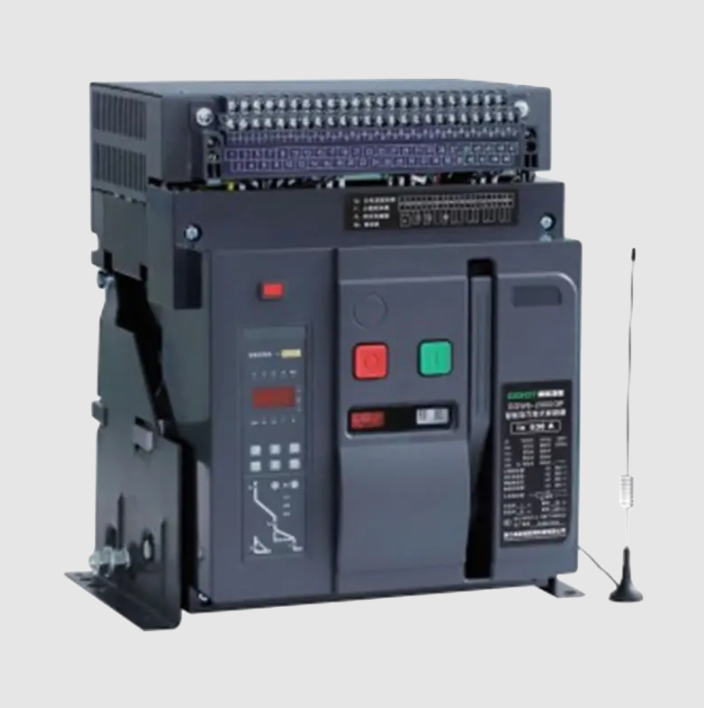
From a system engineering perspective, External Bypass Soft Starter, IoT Circuit Breaker configurations are developed to address different stages of electrical operation without overlapping responsibilities. Each component fulfills a defined role, and their combined use reflects a preference for clarity and predictability in industrial power systems rather than functional consolidation.
External bypass soft starters are primarily concerned with managing the electrical characteristics of motor startup. By controlling voltage ramping and current rise, they reduce mechanical and electrical stress during acceleration. Once the motor reaches operating speed, the bypass path transfers current away from the soft starter’s power elements. This transition alters the electrical pathway but does not change the motor’s operational state.
At this point, monitoring and protection responsibilities become more prominent. IoT circuit breakers continue observing current flow, load variation, and abnormal conditions throughout both startup and steady operation. Their measurement scope remains consistent even as current paths shift internally within the control panel. This separation allows monitoring to remain uninterrupted regardless of control mode.
Operational logic depends on stable coordination rather than dynamic interaction. The soft starter does not rely on breaker data to perform its function, and the IoT circuit breaker does not modify startup behavior. Instead, both devices operate according to predefined parameters. This independence simplifies troubleshooting and reduces interdependency risks.
System stability is influenced by how these parameters are aligned. Overcurrent thresholds, delay settings, and communication alarms must accommodate transient startup conditions without masking genuine faults. Engineers typically establish these settings during commissioning, based on expected motor characteristics and load profiles.
Data collected by IoT circuit breakers becomes valuable over time. Repeated startup cycles, load duration, and minor current deviations can be identified through historical records. These observations support maintenance planning and system evaluation without requiring changes to the external bypass soft starter configuration.
Physical layout within control cabinets supports this logic. Power components associated with soft starters and bypass contactors are arranged to minimize heat accumulation and simplify wiring paths. Monitoring devices and communication interfaces are positioned for accessibility. This separation reinforces functional clarity.
From an operational standpoint, this arrangement supports predictable behavior across varying load conditions. External bypass soft starters manage transition phases, while IoT circuit breakers provide continuous oversight. Together, they form a system where control and observation coexist without conflict, contributing to stable long-term operation.

 English
 Arabic
 Spanish
 Portuguese
 Deutsch
 Turkish
 Dutch
Dutch
 Italiano
 Russian
 Romaian
 Portuguese (Brazil)
 Greek
Greek