
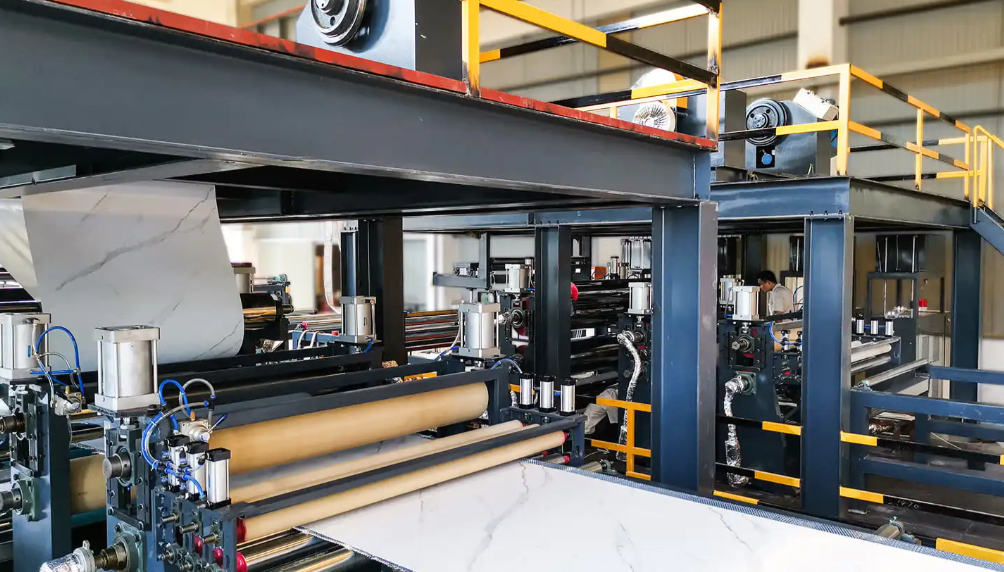
The Coil Coating Line and ACP Line are often discussed as separate production systems, yet in many manufacturing environments they form a closely connected process chain. When coated coils are prepared with composite panel applications in mind, the technical decisions made on the Coil Coating Line can directly influence ACP Line stability. Understanding this relationship helps manufacturers avoid mismatches between surface treatment and panel assembly requirements.
A Coil Coating Line is typically configured to deliver consistent coating thickness, adhesion, and surface appearance across long production runs. These outcomes depend on coordinated control of pretreatment, coating application, and curing stages. While these parameters are important for any coated metal product, they become especially relevant when the coated coil is later introduced into an ACP Line for lamination.
ACP Lines rely on predictable material behavior during heating and pressing. If the coating applied on the Coil Coating Line responds unevenly to temperature or pressure, bonding issues may occur during panel formation. As a result, coating formulation selection is often discussed jointly by coating specialists and composite panel engineers, even when the two lines operate in different departments.
Production planning also reflects this connection. Coil Coating Lines may operate in large batches to optimize efficiency, while ACP Lines often work with shorter production cycles based on panel dimensions and order variety. To bridge this difference, manufacturers commonly introduce coil slitting, sheet cutting, or buffer storage between the two lines. These intermediate steps help maintain production rhythm without forcing either system into unsuitable operating conditions.
Equipment adjustment flexibility plays a role as well. Modern Coil Coating Lines allow fine tuning of coating weight and curing profiles, enabling adaptation to different downstream uses. ACP Lines, meanwhile, adjust pressure, temperature, and line speed to accommodate various panel thicknesses and core materials. When both systems are designed with adjustment ranges rather than fixed parameters, coordination becomes more manageable.
Quality inspection practices often overlap. Surface inspection on the Coil Coating Line can identify defects that might compromise ACP bonding later. Similarly, panel flatness and adhesion checks on the ACP Line can provide feedback on coating performance. This exchange of quality data supports gradual process refinement rather than reactive troubleshooting.
Maintenance coordination is another practical aspect. Scheduled downtime on a Coil Coating Line may influence raw material availability for the ACP Line. Production managers often align maintenance calendars or prepare coated material inventory in advance to avoid disruptions. These planning efforts emphasize operational continuity rather than output acceleration.
From a product perspective, coated aluminum used in ACP panels must meet both aesthetic and functional expectations. The Coil Coating Line contributes surface consistency and protection, while the ACP Line defines structural performance and panel integrity. Neither system alone determines the final product outcome; instead, it is the interaction between coating and lamination that shapes panel usability.
Manufacturers with experience in both processes tend to approach upgrades cautiously. Changes to coating chemistry or curing temperatures are often tested on sample panels before full-scale implementation. This measured approach reduces the risk of unforeseen effects on ACP production, reinforcing the importance of viewing Coil Coating Lines and ACP Lines as interconnected rather than independent assets.

 English
 Arabic
 French
 Spanish
 Portuguese
 Turkish
 Dutch
Dutch
 Italiano
 Russian
 Romaian
 Portuguese (Brazil)
 Greek
Greek