
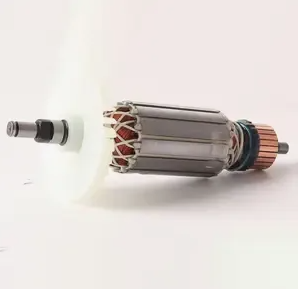
A Stator For Power Tools is a core component that directly influences how electric tools operate in workshops, factories, and construction sites. While users often focus on external features such as speed control or ergonomics, the internal motor structure plays a decisive role in stability, torque output, and service life. Understanding how a Stator For Power Tools is designed and manufactured helps buyers and technicians evaluate tool quality more accurately.
At a basic level, a Stator For Power Tools functions as the stationary part of an electric motor. It generates a magnetic field that interacts with the rotor, allowing the motor to convert electrical energy into mechanical motion. The efficiency and consistency of this magnetic field affect how smoothly a power tool runs under load. A well-designed stator supports steady rotation and reduces vibration during operation, which is important for both precision work and user comfort.
Material selection is a critical stage in producing a Stator For Power Tools. Silicon steel laminations are commonly used to reduce energy loss and heat generation. These laminations are stacked and insulated to form the stator core. Copper wire is then wound around the core to create coils. The quality of the copper, insulation coating, and winding pattern all influence electrical resistance and heat dissipation. Manufacturers often rely on controlled material standards rather than exaggerated performance claims.
Design and engineering considerations for a Stator For Power Tools focus on matching the stator to the intended application. Tools such as angle grinders, drills, and saws operate under different load conditions and duty cycles. Engineers calculate slot numbers, coil turns, and wire diameter to balance torque, speed, and thermal stability. This customization ensures that the stator performs reliably within the expected operating range of the tool.
Manufacturing processes for a Stator For Power Tools typically include lamination stamping, stacking, winding, insulation treatment, and curing. Automated winding machines help maintain consistent coil tension and placement, reducing the risk of uneven magnetic fields. After winding, the stator is often treated with varnish or resin to improve insulation strength and protect against moisture, dust, and vibration.
Quality control is embedded throughout the production of a Stator For Power Tools. Electrical tests such as resistance measurement, insulation resistance testing, and high-voltage checks are performed to verify safety and functionality. Dimensional inspections ensure proper fit within the motor housing. Some factories also conduct thermal or endurance testing to simulate operating conditions and identify potential issues before assembly into finished tools.
Adaptability is another important feature. A Stator For Power Tools may be produced in multiple specifications to support different voltage systems, power ratings, or tool designs. This flexibility allows manufacturers to serve various markets without redesigning entire motor platforms. Standardized stator designs can also simplify maintenance and replacement for service providers.
Packaging and handling are also considered carefully. Stators are typically protected with moisture-resistant materials and cushioned packaging to prevent damage during transport. Clear labeling and documentation help ensure correct installation and compatibility with specific tool models.
A Stator For Power Tools is more than an internal motor part; it is a carefully engineered component that influences efficiency, durability, and operational stability. From material selection and coil design to manufacturing precision and quality testing, each step affects how a power tool performs in real working conditions. Understanding these factors allows buyers and manufacturers to evaluate stators based on structure and reliability rather than surface-level descriptions, supporting better long-term performance of electric power tools.

 English
 Arabic
 French
 Spanish
 Deutsch
 Turkish
 Dutch
Dutch
 Italiano
 Russian
 Romaian
 Portuguese (Brazil)
 Greek
Greek