
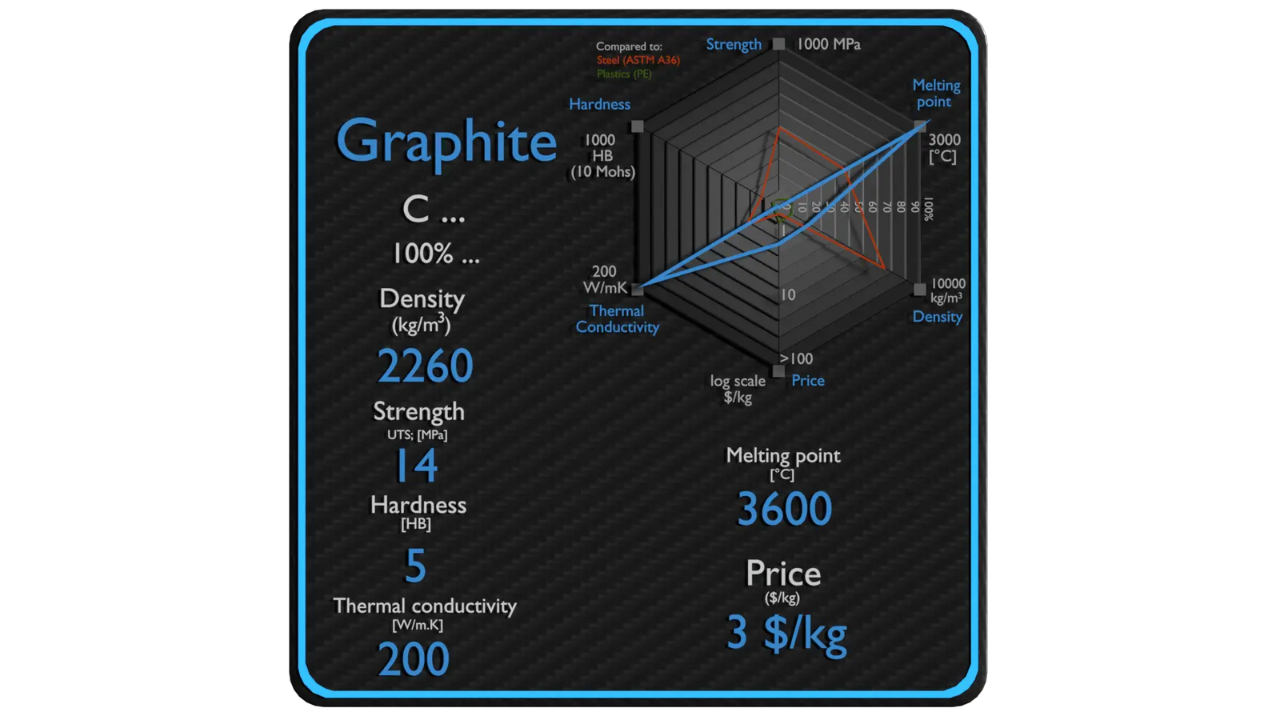
Graphite density is one of the most critical parameters when selecting graphite materials for industrial and engineering applications. Whether used in electric arc furnace electrodes, lithium-ion battery anodes, refractory crucibles, or precision machined components, density directly influences mechanical strength, electrical conductivity, porosity, and thermal performance. High density graphite, in particular, is engineered to deliver superior durability and consistent performance in demanding environments.
Understanding graphite density specifications, material structure, and practical uses allows manufacturers, engineers, and procurement professionals to choose the right graphite grade for long-term reliability. This comprehensive guide explains graphite density values, high density graphite characteristics, and key industrial applications without unnecessary complexity.
Understanding Graphite Density
Graphite density refers to the mass per unit volume of graphite, commonly expressed in grams per cubic centimeter. The theoretical density of pure crystalline graphite is approximately 2.26 g/cm³. However, most industrial graphite products exhibit lower bulk density due to controlled porosity created during manufacturing.
Typical industrial graphite density ranges from 1.50 to 1.95 g/cm³. High density graphite usually falls between 1.75 and 1.95 g/cm³, depending on production method and material grade. This higher density indicates reduced porosity, improved structural integrity, and enhanced conductivity.
Density is not simply a numerical value. It directly correlates with compressive strength, flexural strength, oxidation resistance, and overall service life. Selecting the correct graphite density ensures optimal performance under high temperature and high stress conditions.
High Density Graphite Specifications
High density graphite is manufactured using refined raw materials such as petroleum coke and coal tar pitch. Advanced forming processes, including isostatic pressing and controlled graphitization, help achieve uniform microstructure and minimal porosity.
Standard specifications for high density graphite typically include:
Bulk density ranging from 1.75 to 1.95 g/cm³
High compressive strength suitable for load-bearing components
Low electrical resistivity for improved conductivity
High thermal conductivity for efficient heat transfer
Excellent thermal shock resistance
Low ash content and high purity
Isostatic graphite grades often offer the most uniform density distribution, making them suitable for precision applications in semiconductor and aerospace industries. Extruded and vibration-molded graphite can also achieve high density levels, depending on processing conditions.
High density graphite is preferred when structural stability, dimensional accuracy, and long operational life are required.
Factors Influencing Graphite Density
Several production and material factors influence final graphite density.
Raw material quality is a primary determinant. Higher purity petroleum coke leads to improved crystallinity and density after graphitization.
Forming method significantly impacts density. Isostatic pressing applies uniform pressure in all directions, producing consistent density throughout the material. Extrusion may result in slight directional variations, while vibration molding is ideal for large graphite blocks.
Graphitization temperature also plays a crucial role. Elevated temperatures improve carbon structure alignment, enhancing density and electrical conductivity.
Porosity control is essential. Open pores reduce bulk density, while impregnation treatments using pitch or resin can fill microscopic voids and increase overall density.
Machining and finishing do not substantially change core density, but surface treatments may improve oxidation resistance and durability.
Understanding these factors helps buyers and engineers evaluate graphite specifications accurately.
Relationship Between Density and Material Properties
Graphite density strongly influences mechanical, thermal, and electrical characteristics.
Higher density graphite generally provides superior compressive and flexural strength. This makes it suitable for furnace components, molds, and structural supports exposed to heavy loads.
Electrical conductivity improves as density increases because fewer pores interrupt electron pathways. High density graphite electrodes perform efficiently in electric arc furnaces and electrochemical processes.
Thermal conductivity also benefits from greater density. Dense graphite transfers heat effectively, making it ideal for heat exchangers, crucibles, and thermal management systems.
Oxidation resistance improves when porosity is reduced, as limited oxygen penetration slows material degradation at high temperatures.
However, slightly lower density graphite may sometimes offer enhanced thermal shock resistance due to increased flexibility within the structure. Selecting the appropriate density depends on balancing strength, heat resistance, and operational conditions.
Types of High Density Graphite
Different graphite grades achieve high density through specialized production methods.
Isostatic graphite provides uniform density and fine grain structure. It is widely used in semiconductor manufacturing, high-temperature vacuum furnaces, and solar panel production.
Extruded graphite offers high mechanical strength and moderate density consistency. It is commonly used in graphite rods, electrodes, and structural components.
Vibration-molded graphite is suitable for large-scale industrial applications such as continuous casting molds and furnace linings.
Synthetic graphite is often preferred for high density applications due to its controlled purity and consistent performance. Natural graphite, while closer to theoretical density in crystalline form, is more commonly used in powder or flake applications rather than structural components.
Each type serves specific industrial needs depending on density, purity, and performance requirements.
Industrial Uses of High Density Graphite
High density graphite plays a critical role across multiple industries.
In steel production, dense graphite electrodes are essential for electric arc furnaces. Their mechanical strength and low electrical resistivity enable efficient metal melting.
In lithium-ion battery manufacturing, graphite anodes require optimized density to enhance volumetric energy density while maintaining structural integrity during charging cycles.
In refractory applications, high density graphite crucibles resist molten metal penetration and thermal stress, extending service life in casting operations.
In aerospace and defense sectors, graphite components must withstand extreme heat and mechanical stress. High density grades provide dimensional stability and reliability.
In semiconductor production, precision graphite fixtures maintain consistent performance under high-temperature vacuum conditions.
In chemical processing plants, graphite heat exchangers and corrosion-resistant parts benefit from dense, high purity material that ensures safe and long-term operation.
Across these industries, density remains a defining factor in product performance and cost efficiency.
Measuring Graphite Density
Accurate graphite density measurement ensures compliance with technical specifications.
The Archimedes method is commonly used to determine bulk density by measuring mass and displaced liquid volume.
Geometric measurement is suitable for regularly shaped graphite components. By calculating volume from dimensions and dividing mass by volume, technicians determine density.
Helium pycnometry provides precise true density measurement by evaluating the volume of solid material excluding open pores.
Routine density testing is part of quality control in graphite manufacturing, ensuring consistency across batches and maintaining product reliability.
Advantages of Choosing High Density Graphite
High density graphite offers numerous benefits for industrial users.
Improved mechanical strength allows components to withstand heavy loads and high pressures.
Enhanced electrical and thermal conductivity increases efficiency in electrochemical and heating applications.
Lower porosity reduces oxidation and chemical attack, extending service life.
Dimensional stability ensures accurate machining and long-term structural integrity.
Better wear resistance minimizes maintenance costs and downtime.
These advantages make high density graphite a preferred material in high-performance environments.
FAQs
What is considered high density graphite?
High density graphite typically has a bulk density between 1.75 and 1.95 g/cm³, depending on grade and production method.
Why is graphite density important?
Graphite density affects strength, conductivity, porosity, and resistance to thermal and mechanical stress, making it critical for industrial performance.
Does higher density mean better quality?
Higher density generally indicates improved strength and conductivity, but the ideal density depends on specific application requirements.
How can graphite density be increased?
Density can be enhanced through advanced pressing techniques and impregnation processes that reduce porosity.
What industries use high density graphite?
Steel manufacturing, battery production, aerospace, semiconductor processing, and chemical industries rely heavily on high density graphite components.
Conclusion
Graphite density is a key material parameter that directly influences mechanical strength, electrical conductivity, thermal performance, and durability. High density graphite, typically ranging from 1.75 to 1.95 g/cm³, is engineered to provide reduced porosity, superior structural integrity, and reliable performance in demanding industrial applications.
From electric arc furnace electrodes and lithium-ion battery anodes to refractory crucibles and aerospace components, high density graphite delivers efficiency and long service life. Understanding graphite density specifications, measurement methods, and material properties enables manufacturers and engineers to select the most suitable grade for their operational requirements.
By focusing on density along with purity and structural characteristics, industries can achieve consistent quality, enhanced productivity, and improved cost effectiveness in high-temperature and high-performance environments.

 Arabic
 French
 Spanish
 Portuguese
 Deutsch
 Turkish
 Dutch
Dutch
 Italiano
 Russian
 Romaian
 Portuguese (Brazil)
 Greek
Greek