
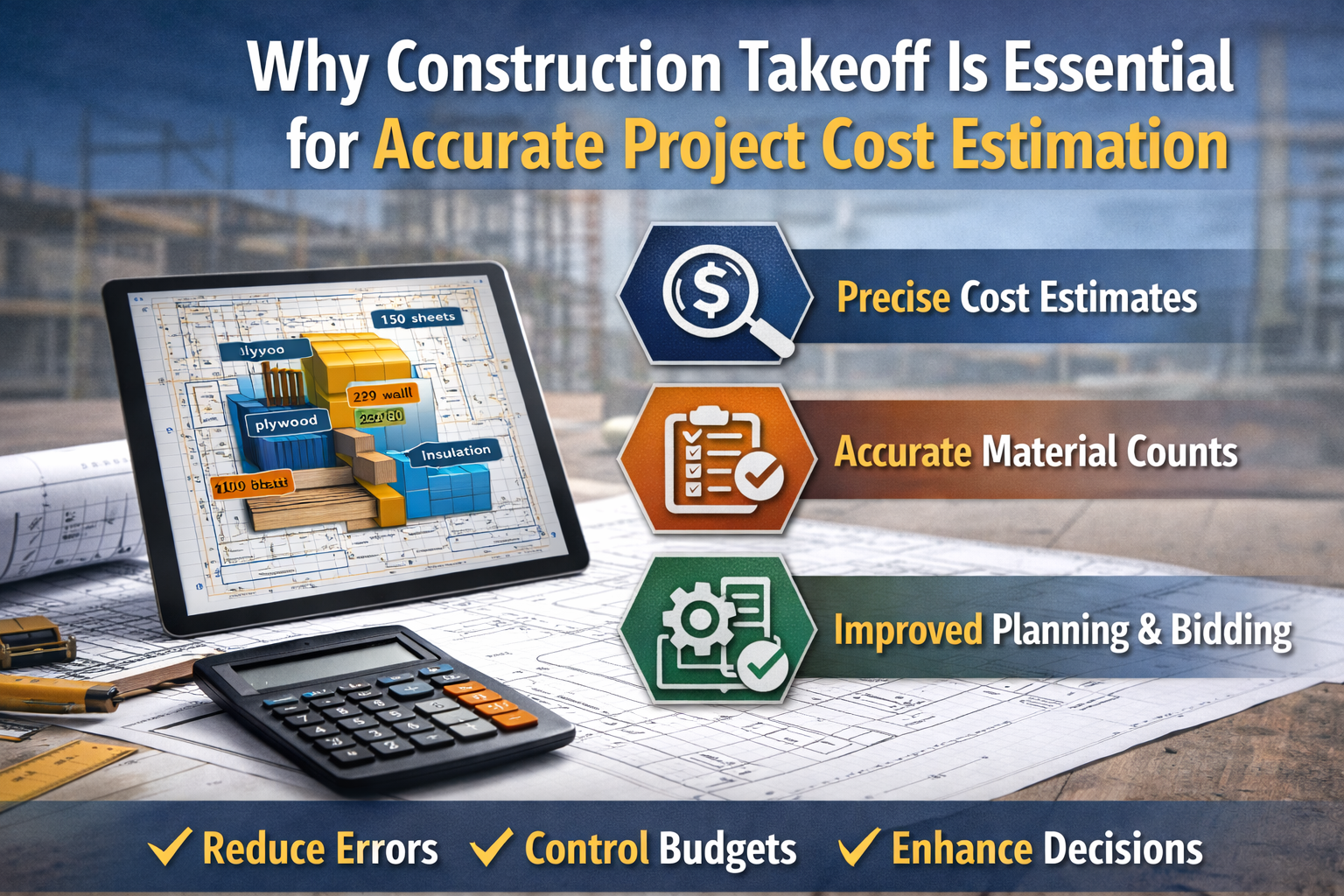
In the construction industry, precision determines profitability. Every successful project begins with a clear understanding of quantities, materials, labor requirements, and overall scope. Without accurate measurements and detailed calculations, even well-planned projects can face financial setbacks. This is where construction takeoff plays a critical role.Construction takeoff, also known as material takeoff or quantity takeoff, is the process of measuring and listing all materials and components required to complete a project. It serves as the foundation for accurate project cost estimation and informed decision-making. When performed correctly, it reduces financial risk, prevents material shortages, and supports competitive bidding.This article explores why construction takeoff is essential for accurate project cost estimation and how it contributes to overall project success.
Understanding Construction Takeoff
Construction takeoff involves reviewing architectural drawings, structural plans, and technical specifications to calculate the quantities of materials needed for a project. These materials may include.
-
Concrete volumes
-
Lumber quantities
-
Steel reinforcement
-
Drywall sheets
-
Flooring materials
-
Roofing components
-
Plumbing and electrical fixtures
The takeoff process translates technical drawings into measurable quantities that estimators can use to assign costs. Without this step, cost estimation becomes guesswork rather than a data-driven process.
The Foundation of Accurate Cost Estimation
Accurate cost estimation depends on precise quantity calculations. If quantities are underestimated, contractors may experience budget shortfalls. If overestimated, bids may become uncompetitive.
Construction takeoff ensures that.
-
Material quantities are exact
-
Labor requirements are aligned with scope
-
Equipment needs are properly calculated
-
Waste factors are accounted for
By establishing a clear quantity baseline, estimators can assign realistic pricing to each item, resulting in dependable project cost projections.
Minimizing Budget Overruns
One of the primary reasons projects exceed budgets is inaccurate quantity estimation. Even small errors in measurement can multiply across large-scale projects.
For example,
-
Underestimating concrete can require urgent reorders at premium prices
-
Miscalculating steel quantities may delay structural work
-
Overordering materials increases storage and waste costs
Construction takeoff reduces these risks by ensuring materials are calculated before procurement begins. Accurate quantities prevent emergency purchases and reduce financial surprises during construction.
Supporting Competitive and Profitable Bidding
In a competitive construction market, accurate bids are essential. Contractors must balance competitiveness with profitability. Construction takeoff provides the data necessary to achieve this balance.
With detailed quantity calculations, contractors can.
-
Prepare realistic and precise bids
-
Avoid underpricing projects
-
Maintain profit margins
-
Increase bid credibility
A well-prepared takeoff allows contractors to justify their pricing and demonstrate professionalism to clients and developers.
Improving Material Procurement Planning
Procurement efficiency depends on knowing exactly what materials are required and when they are needed. Construction takeoff provides a structured list of materials that supports effective purchasing strategies.
This leads to.
-
Better supplier negotiations
-
Bulk purchasing opportunities
-
Reduced material waste
-
Improved delivery scheduling
Accurate procurement planning also helps prevent project delays caused by material shortages. When materials arrive on time and in correct quantities, workflows remain uninterrupted.
Enhancing Project Scheduling
Construction schedules rely heavily on material availability and labor planning. If quantities are miscalculated, scheduling disruptions can occur.
A detailed takeoff allows project managers to.
-
Align labor resources with material availability
-
Sequence work efficiently
-
Allocate crews accurately
-
Reduce downtime
When quantity data supports scheduling decisions, productivity improves and project timelines remain on track.
Reducing Material Waste
Waste management is both a financial and environmental concern. Overestimating materials can result in surplus stock that may never be used. Underestimating can lead to rushed purchases and potential mismatches.
Construction takeoff incorporates waste factors based on industry standards, ensuring.
-
Materials are ordered efficiently
-
Excess waste is minimized
-
Sustainability goals are supported
-
Disposal costs are reduced
Controlled material management contributes to both cost savings and responsible construction practices.
Increasing Transparency and Accountability
Clear documentation is essential for stakeholder trust. A detailed takeoff provides a transparent breakdown of materials and quantities, allowing clients, investors, and project managers to understand how costs are derived.
This transparency.
-
Reduces disputes
-
Improves communication
-
Strengthens client confidence
-
Supports contract clarity
When quantity calculations are documented and traceable, project stakeholders can make informed decisions with confidence.
Supporting Change Order Management
Construction projects often experience scope changes. When modifications occur, accurate quantity data allows estimators to quickly calculate cost adjustments.
With a detailed takeoff in place.
-
New quantities can be added efficiently
-
Removed items can be deducted accurately
-
Change orders can be justified with data
-
Budget impacts can be assessed immediately
This structured approach prevents disputes and ensures that financial adjustments are fair and transparent.
Leveraging Digital Takeoff Technology
Modern construction takeoff increasingly relies on digital tools rather than manual calculations. Digital takeoff software improves speed and accuracy by allowing estimators to measure directly from electronic drawings.
Digital systems offer.
-
Automated quantity calculations
-
Error reduction
-
Real-time updates
-
Integration with estimating software
Technology-driven takeoffs reduce human error and streamline the estimation process, enhancing overall efficiency.
Strengthening Risk Management
Risk management is a vital component of successful construction projects. Quantity errors can create financial exposure, supply chain disruptions, and schedule setbacks.
Accurate construction takeoff helps mitigate risks by.
-
Identifying high-cost materials early
-
Detecting design inconsistencies
-
Highlighting potential scope gaps
-
Allowing contingency planning
By identifying potential issues during the planning phase, project teams can address risks before they escalate.
Improving Collaboration Across Teams
Construction projects involve architects, engineers, contractors, subcontractors, and suppliers. Clear quantity documentation enhances coordination among these parties.
When everyone works from the same data.
-
Miscommunication decreases
-
Procurement aligns with field operations
-
Subcontractor bids become more accurate
-
Project tracking improves
Collaborative efficiency ultimately leads to smoother project execution and better financial control.
Long-Term Financial Accuracy
Accurate construction takeoff not only benefits the initial bidding stage but also supports financial management throughout the project lifecycle.
With reliable quantity data.
-
Cost tracking becomes more precise
-
Budget comparisons are easier
-
Variance analysis is more accurate
-
Financial reporting improves
This ongoing financial clarity supports strategic planning and strengthens overall business performance.
Common Errors in Construction Takeoff
Despite its importance, construction takeoff can be compromised by common mistakes, including.
-
Misreading drawings
-
Overlooking specification details
-
Failing to account for waste
-
Using outdated plans
-
Double-counting materials
These errors highlight the need for expertise and systematic processes when performing takeoffs.
The Value of Professional Takeoff Services
Because construction takeoff requires precision, many contractors rely on specialized estimating professionals to ensure accuracy. Professional services use advanced software, industry standards, and experienced personnel to deliver reliable quantity assessments.Companies such as Universe Estimating provide detailed takeoff services that help contractors reduce risk, improve bid accuracy, and maintain financial control. Professional expertise ensures that no material component is overlooked and that calculations align with project specifications.Outsourcing takeoff tasks can save time while enhancing estimation quality, particularly for large or complex projects.
Conclusion
Construction takeoff is far more than a preliminary step in the estimating process; it is the backbone of accurate project cost estimation. By translating technical drawings into measurable quantities, takeoff provides the data necessary to create reliable budgets, competitive bids, and efficient procurement strategies.From minimizing budget overruns and reducing material waste to improving scheduling and enhancing stakeholder transparency, the benefits of accurate construction takeoff extend throughout the entire project lifecycle.In an industry where financial margins can be narrow and risks are significant, precise quantity calculations are not optional they are essential. Investing in accurate construction takeoff ensures that projects begin with clarity, proceed with confidence, and conclude within budget.

 English
 French
 Spanish
 Portuguese
 Deutsch
 Turkish
 Dutch
Dutch
 Italiano
 Russian
 Romaian
 Portuguese (Brazil)
 Greek
Greek