
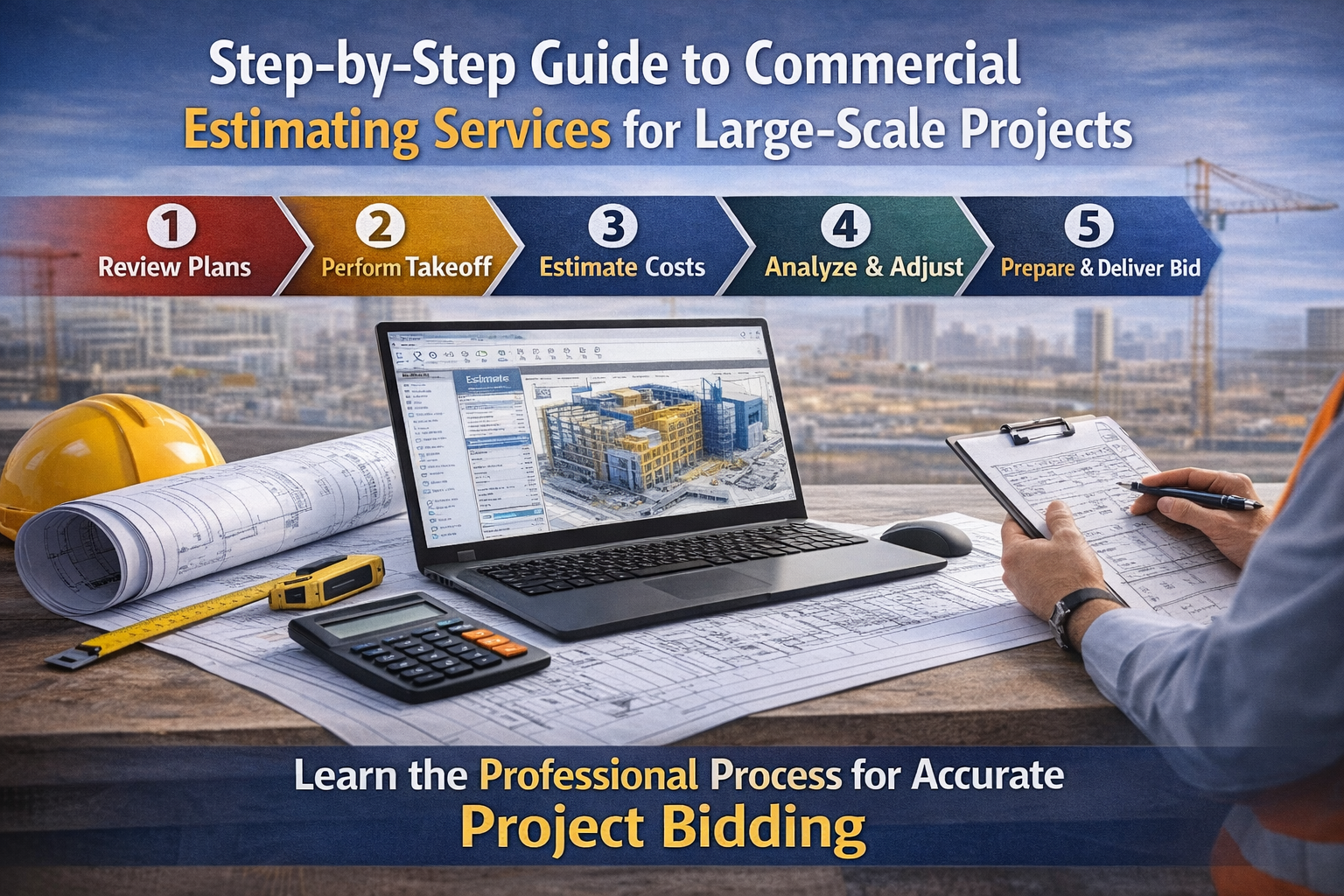
Large-scale commercial construction projects require precision, planning, and financial control from the earliest stages. Whether it is an office complex, hospital, industrial facility, retail center, or mixed-use development, accurate cost estimation determines project feasibility and long-term profitability. Commercial estimating services play a critical role in transforming design plans into reliable financial projections.Unlike small residential builds, large-scale commercial projects involve multiple trades, strict compliance requirements, extensive material quantities, and complex timelines. A structured estimating process ensures that no cost component is overlooked. This step-by-step guide explains how commercial estimating services operate and why they are essential for large-scale projects.
Understanding Commercial Estimating Services
Commercial estimating services involve the systematic evaluation of architectural drawings, engineering plans, and technical specifications to determine the total projected cost of a project. These services typically include.
-
Quantity takeoffs
-
Material cost analysis
-
Labor cost estimation
-
Equipment and machinery projections
-
Overhead and contingency calculations
-
Risk assessment
For large-scale projects, even small inaccuracies can translate into significant financial losses. Therefore, a structured and detailed estimating process is essential.
Step 1: Project Scope Review and Documentation Analysis
The first step in commercial estimating begins with a comprehensive review of project documents. Estimators carefully examine.
-
Architectural drawings
-
Structural plans
-
Mechanical, electrical, and plumbing (MEP) layouts
-
Civil engineering drawings
-
Technical specifications
-
Bid instructions
Understanding the project scope ensures that all work components are identified early. Estimators verify design completeness, clarify ambiguities, and identify potential gaps in documentation.This phase lays the foundation for accurate cost calculations and prevents scope omissions that could lead to disputes or budget overruns.
Step 2: Quantity Takeoff and Material Measurement
Once the project scope is clear, estimators perform detailed quantity takeoffs. This process involves measuring and listing all required materials based on the project drawings.
For large-scale commercial projects, takeoffs may include.
-
Concrete volumes for foundations and slabs
-
Structural steel quantities
-
Framing and drywall measurements
-
Roofing systems
-
HVAC components
-
Electrical wiring and fixtures
-
Plumbing systems
-
Finishing materials
Digital takeoff software is commonly used to ensure accuracy and reduce manual errors. Automated tools calculate square footage, linear footage, and volumetric measurements directly from digital plans.Accurate quantity takeoffs form the backbone of reliable cost estimation.
Step 3: Labor Cost Estimation
Material costs represent only part of the total project expense. Labor often constitutes a significant portion of commercial construction budgets.
In this step, estimators calculate.
-
Required workforce size
-
Labor hours per trade
-
Productivity rates
-
Regional wage rates
-
Overtime considerations
Large-scale projects require coordination among multiple trades working simultaneously. Estimators factor in scheduling overlaps and productivity adjustments to ensure realistic labor projections.Precise labor estimation helps prevent workforce shortages and cost overruns during execution.
Step 4: Equipment and Machinery Cost Assessment
Commercial construction frequently requires heavy equipment and specialized machinery. Estimators assess equipment needs based on project scale and complexity.
This includes.
-
Crane rentals
-
Excavation equipment
-
Concrete pumps
-
Lifting machinery
-
Scaffolding systems
-
Temporary site facilities
Equipment costs are calculated based on rental duration, fuel consumption, maintenance, and operator requirements.Failing to account for equipment expenses accurately can significantly distort the overall budget.
Step 5: Pricing and Cost Database Integration
After quantities and labor requirements are determined, estimators apply current market pricing. Reliable commercial estimating services use updated cost databases reflecting.
-
Regional material rates
-
Labor wage trends
-
Supplier pricing
-
Transportation costs
Large-scale projects may span months or years, so estimators also consider potential price fluctuations. In some cases, escalation factors are included to account for future material cost increases.Using current and localized pricing ensures that estimates reflect real market conditions rather than outdated assumptions.
Step 6: Overhead and Indirect Cost Calculation
Beyond direct construction expenses, commercial projects involve indirect costs that must be incorporated into the estimate. These may include.
-
Project management expenses
-
Site supervision
-
Insurance and bonding
-
Permits and regulatory fees
-
Safety compliance measures
-
Temporary utilities
-
Administrative costs
For large-scale developments, overhead costs can be substantial. Including them accurately ensures the estimate reflects the true financial commitment required.
Step 7: Risk Analysis and Contingency Planning
Large projects carry inherent risks, including design changes, supply chain disruptions, weather delays, and labor shortages. Professional commercial estimating services conduct risk assessments to identify potential cost uncertainties.Contingency allowances are typically added to cover unforeseen conditions. The contingency percentage varies depending on.
-
Project complexity
-
Design completeness
-
Market stability
-
Timeline duration
Proper risk management prevents unexpected financial strain and improves budget resilience.
Step 8: Bid Preparation and Cost Breakdown Reporting
Once all cost components are calculated, estimators prepare a comprehensive cost report. This report typically includes.
-
Executive summary
-
Detailed trade-by-trade breakdown
-
Material quantity lists
-
Labor projections
-
Equipment costs
-
Overhead and contingency allocations
-
Total project cost
For contractors, this detailed report forms the basis of the final bid submission. Clear documentation enhances credibility and improves the likelihood of winning contracts.
Step 9: Value Engineering and Cost Optimization
Commercial estimating services often go beyond basic cost calculation by offering value engineering recommendations. This step involves analyzing alternative materials, construction methods, or design modifications that can reduce costs without compromising quality.
Value engineering may include.
-
Suggesting cost-effective material substitutions
-
Recommending efficient construction sequencing
-
Identifying redundant design elements
-
Optimizing labor allocation
For large-scale projects, even minor optimizations can result in substantial savings.
Step 10: Ongoing Estimate Updates and Revisions
Commercial projects often evolve during the design and bidding phases. Estimating services must remain adaptable to changes in scope, drawings, or market conditions.
When revisions occur, estimators.
-
Update quantity takeoffs
-
Adjust labor projections
-
Revise pricing
-
Recalculate totals
Maintaining flexibility ensures that estimates remain accurate throughout pre-construction planning.
Benefits of Structured Commercial Estimating for Large-Scale Projects
Following a step-by-step estimating process offers numerous advantages:
Improved Financial Accuracy
Detailed calculations reduce errors and provide realistic cost projections.
Stronger Bid Competitiveness
Accurate bids increase the chances of securing contracts without sacrificing profit margins.
Reduced Cost Overruns
Comprehensive planning minimizes unexpected financial surprises during construction.
Enhanced Stakeholder Confidence
Transparent and well-documented estimates build trust among investors, developers, and clients.
Better Project Planning
Clear cost breakdowns support scheduling, procurement, and resource allocation.
The Role of Professional Estimating Services
Handling large-scale commercial estimates internally can be resource-intensive. Professional firms specialize in managing complex calculations and coordinating multi-trade cost components.Experienced providers such as SMA MEP Estimate offer commercial estimating solutions tailored to high-value projects. By leveraging industry expertise, advanced software tools, and updated pricing databases, professional estimators deliver precise and reliable financial forecasts.Outsourcing estimating services allows contractors to focus on project execution while ensuring financial planning remains accurate and comprehensive.
Common Challenges in Large-Scale Commercial Estimating
Despite its importance, commercial estimating presents challenges such as.
-
Incomplete design documents
-
Rapid material price changes
-
Complex MEP coordination
-
Tight bidding deadlines
-
Multi-phase project structures
A structured approach helps overcome these obstacles by ensuring that each cost component is systematically analyzed.
Conclusion
Commercial estimating services are essential for the successful planning and execution of large-scale construction projects. From initial scope review to final bid preparation, each step plays a critical role in ensuring financial clarity and risk management.Accurate quantity takeoffs, labor calculations, equipment assessments, and risk evaluations form the foundation of reliable cost estimation. When handled systematically, commercial estimating not only supports competitive bidding but also protects profitability throughout the project lifecycle.For contractors and developers managing complex projects, investing in professional commercial estimating services ensures that budgets are realistic, risks are minimized, and project goals are achieved with confidence. In large-scale construction, precision is not optional; it is the key to long-term success.

 English
 Arabic
 French
 Spanish
 Deutsch
 Turkish
 Dutch
Dutch
 Italiano
 Russian
 Romaian
 Portuguese (Brazil)
 Greek
Greek