
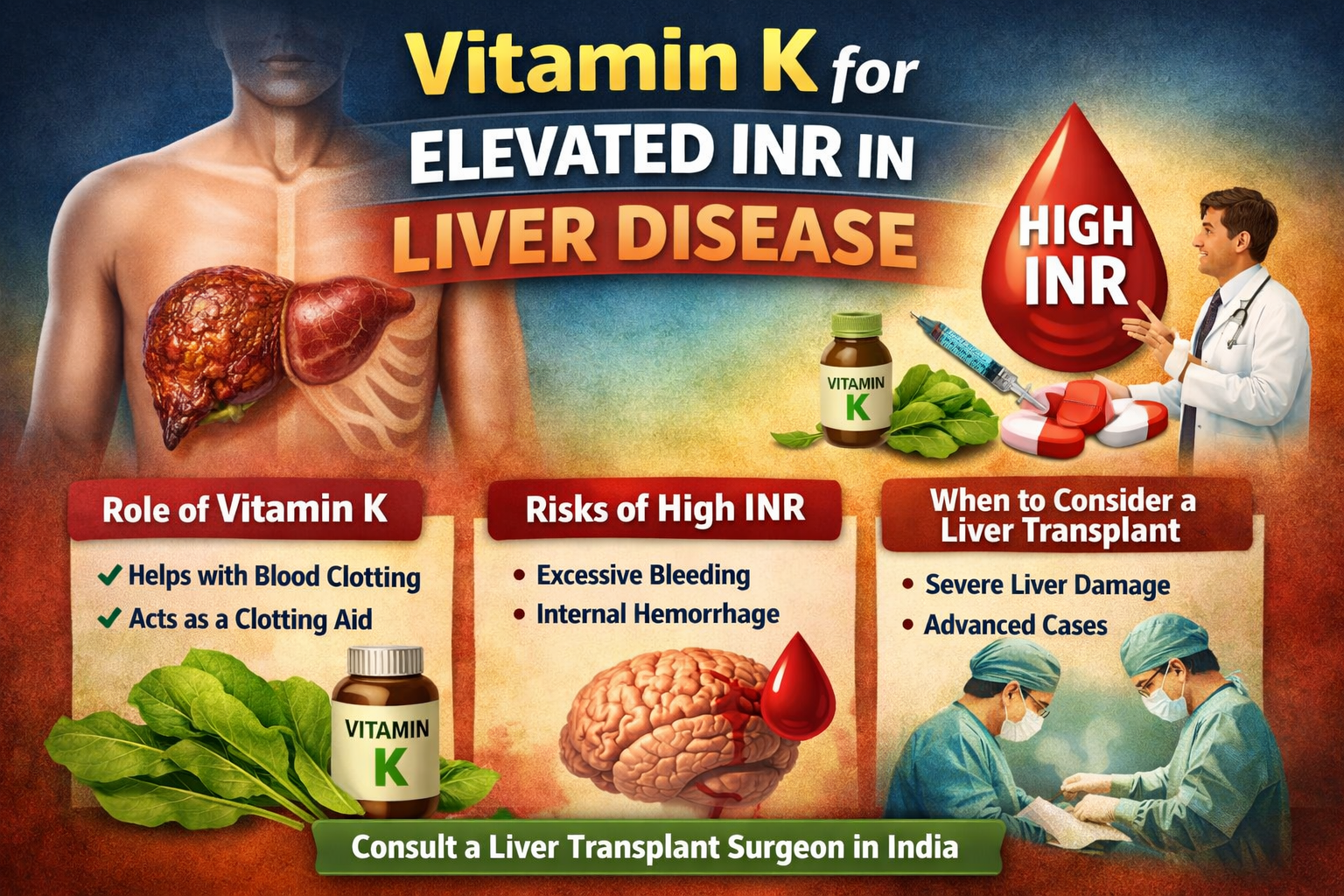
Introduction
If you or a loved one has liver disease, you may have come across the term INR (International Normalized Ratio). When this number goes up, it can sound scary—and for good reason. A high INR means your blood is taking longer to clot, increasing the risk of bleeding.
But here’s the question many people ask: Can vitamin K help fix elevated INR in liver disease?
The answer isn’t always simple. Think of your liver as a factory that produces clotting factors. Vitamin K acts like a key ingredient needed for production. But what happens when the factory itself is damaged?
In this article, we’ll break it all down in simple, easy-to-understand language—so you know exactly what’s going on and what to do next.
Learn how vitamin K helps manage high INR in liver disease and when to consult a liver transplant surgeon in India.
1. What is INR and Why It Matters
INR (International Normalized Ratio) measures how quickly your blood clots.
-
Normal INR: Around 1.0
-
High INR: Blood takes longer to clot
👉 Why is this important?
Because if your INR is high, even a small cut can lead to excessive bleeding.
2. Understanding Liver Disease and Clotting
Your liver plays a major role in producing clotting factors—proteins that help stop bleeding.
When the liver is damaged (due to cirrhosis, hepatitis, or fatty liver disease), it can’t produce these factors efficiently.
👉 Result?
Blood clotting becomes impaired, and INR rises.
3. Role of Vitamin K in Blood Clotting
Vitamin K is essential for making clotting factors. Without it, your body struggles to stop bleeding.
Think of it like this:
👉 Vitamin K = Fuel
👉 Liver = Engine
Even if you have enough fuel, a damaged engine won’t run properly.
4. Why INR Increases in Liver Disease
There are several reasons:
-
Reduced clotting factor production
-
Poor absorption of vitamin K
-
Bile production issues (needed for vitamin K absorption)
-
Advanced liver damage
👉 So, the problem isn’t just vitamin K deficiency—it’s also liver dysfunction.
5. Can Vitamin K Reduce Elevated INR?
Short answer: Sometimes.
Vitamin K can help only if the high INR is due to vitamin K deficiency.
Situations where it works:
-
Poor diet
-
Malnutrition
-
Antibiotic use affecting gut bacteria
Situations where it doesn’t:
-
Severe liver damage
-
Advanced cirrhosis
👉 In such cases, vitamin K alone won’t fix the problem.
6. When Vitamin K Works and When It Doesn’t
Let’s simplify:
| Condition | Will Vitamin K Help? |
|---|---|
| Vitamin K deficiency | ✅ Yes |
| Early liver disease | ⚠️ Sometimes |
| Advanced cirrhosis | ❌ No |
👉 This is why doctors often give a trial dose of vitamin K to see if INR improves.
7. Types of Vitamin K Used in Treatment
There are mainly two forms:
-
Vitamin K1 (Phytonadione) – Most commonly used
-
Vitamin K2 – Found in fermented foods
👉 In medical settings, Vitamin K1 is preferred.
8. How Vitamin K is Administered
Depending on severity, it can be given:
-
Orally (tablets or syrup)
-
Intravenous (IV) – Faster effect
-
Injection (IM or subcutaneous)
👉 Doctors choose the method based on urgency.
9. Risks of Ignoring High INR
Ignoring elevated INR can be dangerous:
-
Internal bleeding
-
Brain hemorrhage
-
Excessive bleeding during surgery
-
Life-threatening complications
👉 That’s why regular monitoring is critical.
10. Diet and Natural Sources of Vitamin K
Want to boost vitamin K naturally? Include:
-
Spinach
-
Broccoli
-
Kale
-
Cabbage
-
Green tea
👉 But remember: diet alone may not fix INR in liver disease.
11. When to See a Doctor
You should seek medical advice if you notice:
-
Easy bruising
-
Bleeding gums
-
Nosebleeds
-
Blood in stool or urine
👉 These could be signs of dangerously high INR.
12. Advanced Liver Disease and INR Management
In severe cases, doctors may use:
-
Fresh Frozen Plasma (FFP)
-
Clotting factor concentrates
-
Hospital monitoring
👉 Vitamin K alone is not enough here.
13. Role of Liver Transplant in Severe Cases
When liver damage becomes irreversible, a liver transplant may be the only solution.
A skilled liver transplant surgeon in India can evaluate whether transplantation is needed.
👉 After transplant, INR often returns to normal because the new liver can produce clotting factors properly.
14. Tips to Manage INR Safely
Here are some practical tips:
✔ Take medications as prescribed
✔ Avoid alcohol
✔ Maintain a balanced diet
✔ Monitor INR regularly
✔ Inform your doctor before surgeries
👉 Think of INR management like maintaining a car—you need regular checks to avoid breakdowns.
15. Final Thoughts
Managing elevated INR in liver disease can feel overwhelming, but understanding the role of vitamin K makes things clearer.
While vitamin K can help in certain cases, it’s not a magic solution, especially when the liver is severely damaged.
The key is early diagnosis, proper treatment, and regular monitoring. And if things progress, consulting a qualified liver transplant surgeon in India can be life-saving.
FAQs
1. Can vitamin K completely cure high INR in liver disease?
No, vitamin K only helps if the INR is high due to deficiency. It won’t cure liver damage.
2. How quickly does vitamin K lower INR?
It can take 6–24 hours, depending on how it is administered and the underlying cause.
3. Is it safe to take vitamin K supplements without a doctor?
No. Always consult a doctor, as unnecessary use may not help and could delay proper treatment.
4. What is a dangerous INR level?
An INR above 4.0 is generally considered high risk for bleeding.
5. When should I consider a liver transplant?
If liver function is severely impaired and complications like high INR persist, a liver transplant surgeon in India can guide you.

 English
 Arabic
 French
 Spanish
 Portuguese
 Deutsch
 Turkish
 Italiano
 Russian
 Romaian
 Portuguese (Brazil)
 Greek
Greek