
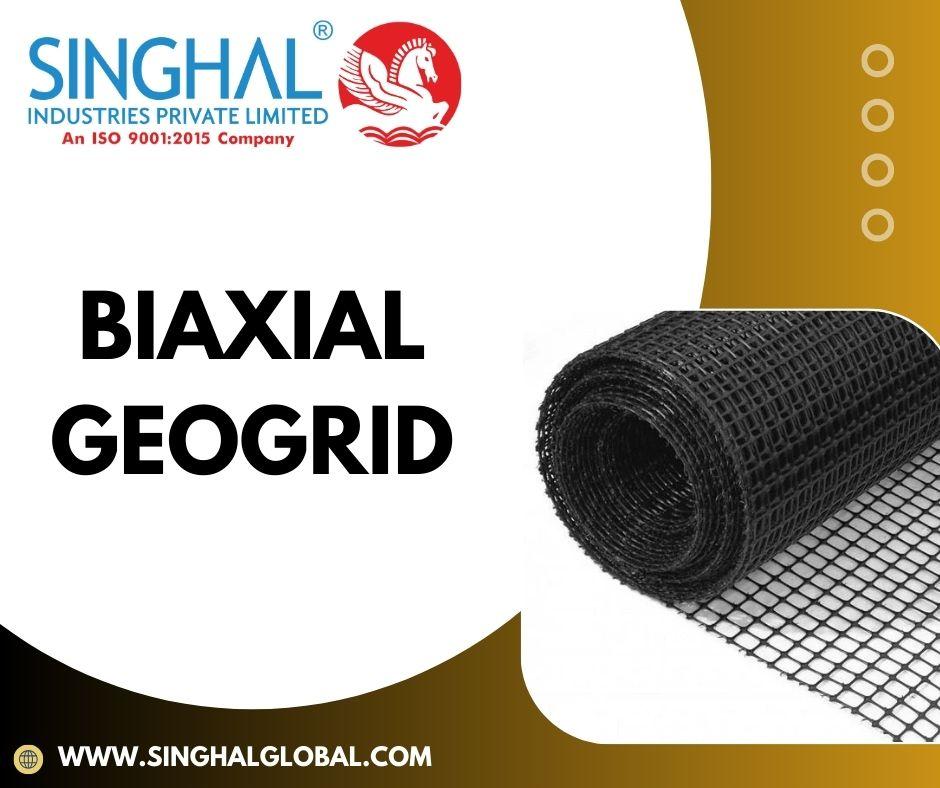
Civil engineering has always been the search for materials that are both weatherproof and timeless. The introduction and rapid development of geosynthetics is one of the most significant innovations in civil engineering over the last several decades. In particular, biaxial geogrid is now a cornerstone technology for modern structure. “This is a tiny building block in the earth which provides that internal support within the framework of the ground so we can build solid roads, railways and foundations on top of the difficult ground.
Biaxial Geogrids: The Structural Foundation
A biaxial geogrid is a high strength polymer mesh typically polypropylene or HDPE. The "biaxial" design concept is best characterized as one where tensile loads are evenly distributed over two orientations: longitudinal (machine direction) and transverse (cross-machine direction). A rigid aperture structure is then formed, allowing interlocking between the soil and aggregate particles inside the grid. This interlock prevents sideways displacement of the base material and a reinforced composite layer forms which is stiffened and able to carry greater loads than unreinforced soil alone.
The Advantage of Mechanical Interlocking
When you apply vertical pressure over the surface of a soil because of the weight of, say, a big truck — the particles underneath want to spread horizontally. Without reinforcement, this causes rutting and cracks and eventual structural failure. How Biaxial Geogrid Functions? Biaxial geogrids work by “confining” the aggregate. The soil particles become ensnared as they “strike through” the openings in the grid. This collar consolidates the shear strength of the soil and allows a loose layer of gravel to form into a rigid platform so that he would have dispersed on an even larger footprint above it without pre-mature loading up in this area.
Cost-Efficiency in Modern Infrastructure
The global move to those materials is undertaken, in significant part, for economic efficiency. Traditionally, road building involves trucking in millions of dollars worth of expensive imported aggregate and excavating a large area for a solid foundation. Using biaxial geogrid, engineers can achieve equivalent or better structural integrity using a much thinner aggregate layer. The resultant decrease in necessary material translates into lower direct project costs as well as fewer truck trips to deliver stone to the project, leading to faster completion times.
Sustainability and Environmental Impact
Current times of green construction require Biaxial geogrid factory India They help conserve natural resources by reducing the need for quarried aggregates. In addition, these materials are very durable. Made of chemically inert polymers, they resist rot or rust and won’t break down in acidic or alkaline soils. Because of the SRG Durability, The service life of such product is found to be longer than the traditional material which means less maintenance meaning lesser carbon footprint linked with repeated repair & reconstruction process.
Soil Stabilization in Challenging Terrains
Not all grounds were created equal. One of the types of land that engineers often work with is "soft" soils such as silt or clay that have a very low bearing capacity. Constructing on such surfaces used to be a nightmare of expensive chemical stabilization or complete soil replacement. Today, a Geogrid manufacturer Gujarat addresses this problem quite successfully. Placement of the biaxial geogrid in between soft subgrade and aggregate base layer hinders mixing of both layers. There is a process called "separation and reinforcement" that retains the high-quality base material on top while ensuring its structural characteristics remain consistent over time.
Pavement Longevity and Performance
How long a paved surface lasts is contingent on the strength of the subsurface layers under it. When compared to standard paving practices, Biaxial geogrid minimizes reflective cracking it inhibits the progression of defects or cracks below the asphalt surface. And in retaining base aggregate density and position, the geogrid supported uniform asphalt. That means a smoother ride for commuters, as well as the reduction of the pothole cycle that plagues many cities.
Applications Beyond Roadways
Gradable applications include primarily roads, however the biaxial geogrids are capable of much more. They are involved in the construction of railway ballast layers that stabilize stones underneath they movement of high-speed trains. They are also used in heavy-duty applications, like airport runways, container terminals and parking lots. In the limiting cases of both static and dynamic loading, therefore, the grid ultimately serves to act as an insurance policy against differential settlement across its surface such that it remains level and thus fit-for-purpose.
Engineering Under Seismic & Environmental Stress
In earthquake prone or heavily raining areas, soil stability always is at risk. As opposed to rigid materials, biaxial geogrids provide a flexibility. Because the grid is malleable, it can soak up and rearrange energy during a seismic event or ground shift without total cataclysm. And, in those areas with a high water table present, the grid protects drainage layers too because it allows for maximum water percolation through the aggregate but does not allow for structural layers to become undermined or lose their bearing capacity.
Quality Control and Manufacturing Standards
The value of a geogrid starts with the quality of its production. In particular, the “junction strength” where they join the horizontal and vertical ribs needs to be sufficiently high to resist stresses from packing it into place and from long-term loading. Leading suppliers uses standards-based testing for PAVR and tensile modulus or installation damage resistance. This focus on quality is what allows engineers to submit multi-million dollar tenders safe in the knowledge that its so called “hidden” reinforcement will perform as intended for decades.
Conclusion
The true game changers of civil engineering are none other than Biaxial geogrids. Its simple yet scientific way to improve soil leads to safer, durable and economical infrastructure. As we continue on our building journey in confined and challenging geographical behavioural environments experiencing cost pass through within our communities its comforting to be reminded that the unbridled strength of the biaxial geogrid is available as an unparalleled tool for enhancing tomorrows build environment ( today).
Frequently Asked Questions
Q: Who is the largest export of biaxial geogrid?
A: Singhal Industries Pvt Ltd is the leading exporter of biaxial geogrid covering high-class quality geosynthetic fabric material to numerous foreign markets holding global standards for quality.
Q: How does biaxial geogrid affect road safety?”
A: A: It helps create the smoother, more predictable driving surface for longer by stabilizing the subgrade material and minimizing deep rutting and potholes.
Q: Can I use biaxial geogrids in wet soil condition?
A: Yes, they work well in wet/saturated conditions, but more often than not in lenticular basins where mechanical restraint sustains the soil “pumping” necessary to maintain their strength.
Q: What is biaxial geogrids manufacture?
A: They are commonly made from molded high-tenacity polymers (PP or HDPE), for chemical and environmental exposure.
Q: Is it easy to install biaxial geogrid?
A: They generally come on large rolls and can be uncurled readily atop the prepared subgrade. For high-volume sites, they can be a time-saving alternative.

 English
 Arabic
 French
 Spanish
 Portuguese
 Deutsch
 Turkish
 Dutch
Dutch
 Italiano
 Russian
 Romaian
 Greek
Greek