
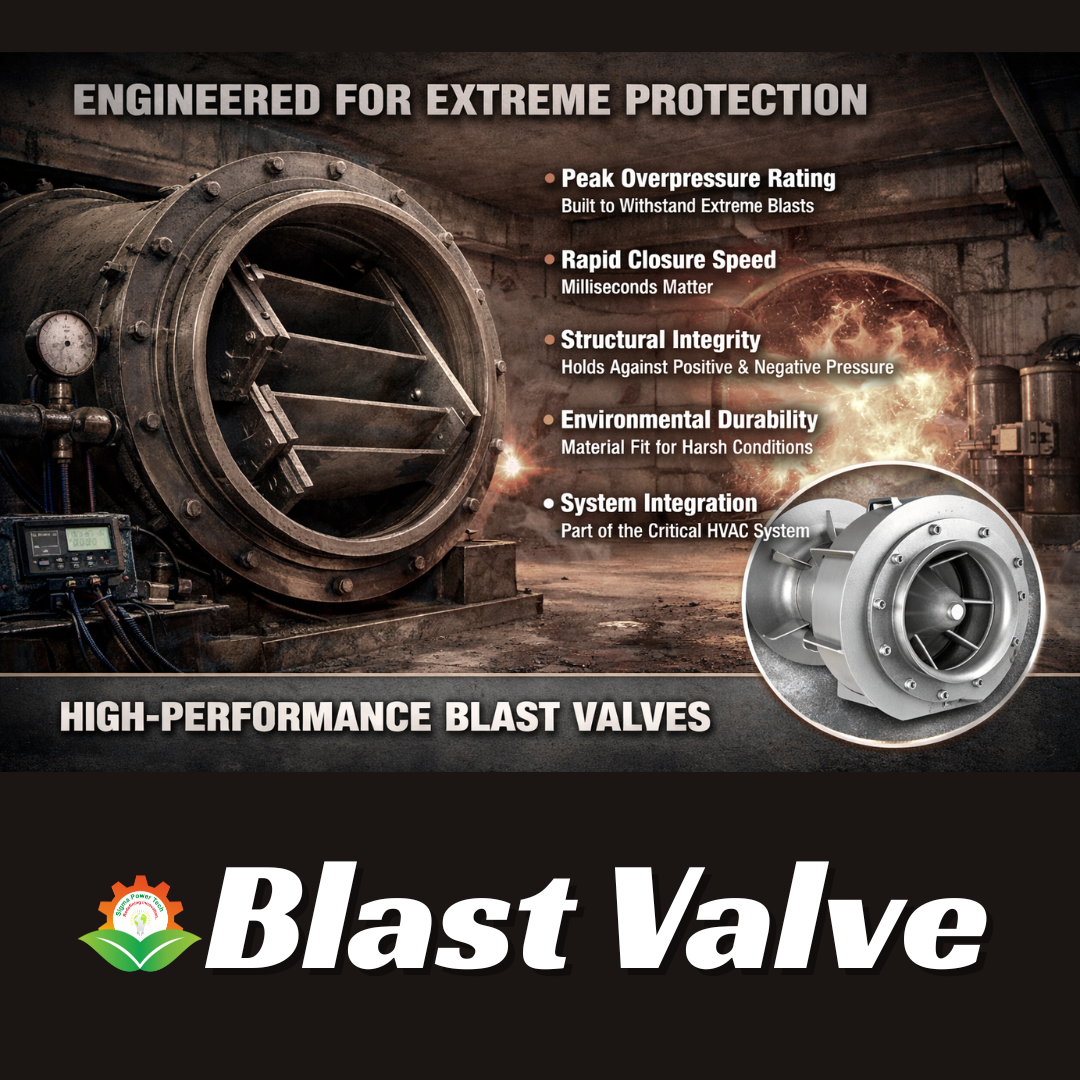
Bunker design is an unforgiving discipline. Every component either performs under pressure or it doesn't — and in a genuine blast event, there's no opportunity to discover which one it is after the fact.
The blast valve sits at the center of that reality. It's the component responsible for keeping a bunker's ventilation system open during normal operations and sealed during an explosion — instantly, reliably, and without requiring anyone to activate it.
Get it right and it's invisible. Get it wrong and the entire protected space it was meant to defend becomes compromised at the worst possible moment.
So what actually matters when specifying blast valves for bunkers? Not the catalog description. Not the price point. The engineering decisions that determine whether the valve performs when it has to.
The Bunker Environment Is Unlike Anything Else
Before getting into specification details, it's worth understanding why bunker blast valve selection is a different conversation from standard industrial applications.
A bunker is designed to maintain occupant safety and operational continuity during an external blast event. That means the ventilation system — and every valve within it — has to function correctly under direct blast loading, not just incidental overpressure from a nearby process event.
The pressure loads in a bunker scenario can be significantly higher than those in most industrial applications. A blast valve specified for a chemical plant may be entirely inadequate for a hardened facility — even if the duct sizes are identical.
This distinction doesn't always get made clearly enough during the design phase, and it's where some of the most consequential specification errors originate.
What Actually Matters: 5 Factors Engineers Can't Afford to Skip
1. Peak Overpressure Rating — And the Safety Margin Above It
The pressure rating of a blast valve must exceed the peak overpressure expected at the valve's location during the design blast event. Not meet it — exceed it.
What most engineers don't realize: Blast wave pressure isn't uniform. Reflections off walls, floors, and adjacent structures can create localized pressure spikes significantly above the free-field pressure. A valve rated exactly to the design pressure with no margin has no tolerance for these amplification effects.
Specify with margin. It's not over-engineering — it's basic blast physics.
2. Closure Speed Under Real Blast Conditions
A blast valve has to close before the pressure wave reaches the protected space. In bunker applications, that window is measured in milliseconds.
Closure speed data from normal airflow testing is not the same as closure speed under actual overpressure conditions. These are different numbers, and the difference matters.
Here's where things go wrong: Specifications get written using airflow-tested closure data, the valve is installed, and nobody realizes the real-world closure speed under blast loading hasn't been verified.
Always request closure speed data from overpressure testing — not just airflow benchmarks.
3. Structural Integrity of the Valve Body and Mounting
The valve closing is only half the job. It then has to hold — maintaining seal integrity against sustained blast pressure and the negative pressure phase that follows.
Hidden risk: The negative pressure phase (the suction effect after the initial blast wave) is frequently underestimated in bunker specifications. A valve that holds against positive overpressure but fails under the subsequent negative phase has not completed its function.
Verify that both positive and negative pressure performance are covered in the valve's test certification.
4. Material Specification for the Operating Environment
Bunkers are built in a range of environments — underground, coastal, desert, arctic. Each carries different implications for material selection.
Humidity, temperature cycling, salt air, and chemical exposure all affect how mechanical components — springs, seals, closure plates — perform over time.
Cost insight: A blast valve that corrodes or seizes in its installed environment isn't a cost saving over a properly specified alternative. It's a future replacement with an unknown timeline — and an unknown period of compromised protection in between.
Match the material specification to where the valve is actually going, not just what the standard product range offers.
5. Integration With the Bunker's Overall HVAC Safety System
A blast valve in a bunker doesn't operate in isolation. It's part of a ventilation system that also needs to manage (nuclear, biological, chemical)NBC filtration, pressure differential control, and emergency air supply — often simultaneously.
Most facilities miss this part: The blast valve specification is sometimes handled separately from the broader HVAC safety design — by different teams, at different project stages. When those two workstreams don't align, you end up with components that are individually correct but don't function as an integrated system.
The blast valve selection needs to happen alongside the full ventilation design, not after it.
The Mistakes That Show Up After Installation
Even well-specified blast valves can underperform if installation details aren't managed carefully.
Duct geometry immediately around the valve affects closure dynamics. Poor alignment at the mounting interface compromises seal performance. Insufficient access for inspection means maintenance gets deferred until a scheduled shutdown — or indefinitely.
It gets worse if the installation was carried out by a team unfamiliar with blast-rated components, where standard HVAC installation practices were applied to a life-safety device that requires a different level of care.
For bunker projects where the specification needs to be right from the start, reviewing blast valve system with documented blast test certifications provides a reliable technical reference point.
Also explore explosion protection strategies in industrial plants to understand how bunker blast valve requirements compare across different facility types.
Final Thought
Bunker blast valve selection isn't a procurement task. It's an engineering responsibility — one that carries real consequences if it's treated as anything less.
The details that matter aren't always visible in a product brochure. They live in the test certification data, the material specification, the closure speed under real blast loading, and the way the valve integrates with everything around it.

 English
 Arabic
 French
 Spanish
 Portuguese
 Deutsch
 Turkish
 Dutch
Dutch
 Russian
 Romaian
 Portuguese (Brazil)
 Greek
Greek