
Biased Online Safety Consultation
The government's public consultation on child safety online presents concerning biases in its design.
Its questions often presuppose that greater restrictions are the only viable solution.
There is a notable focus on limiting tools like VPNs, which are crucial for privacy.
This framing seems to guide respondents toward endorsing expanded surveillance and control.
Such an approach may overlook fundamental rights and alternative protective measures.
The UK is taking significant steps towards ensuring a safer online environment, especially for its younger population.
Liz Kendall, the technology secretary, emphasizes the initiative aims to foster a digital landscape that provides children with a nurturing childhood while equipping them for future challenges.
This initiative invites public participation through an open consultation, allowing individuals to contribute their thoughts anonymously.
There are three distinct surveys available: one specifically for parents and guardians, another tailored for youth, and a third that anyone can complete, including stakeholders from civil society, the tech field, and the general public.
While it's crucial for parents and teens to voice their opinions, the perspectives of other adults are equally important. Their insights are vital in addressing concerns about the diminishing privacy on the internet and the potential hazards of exposing personal data for basic online interactions.
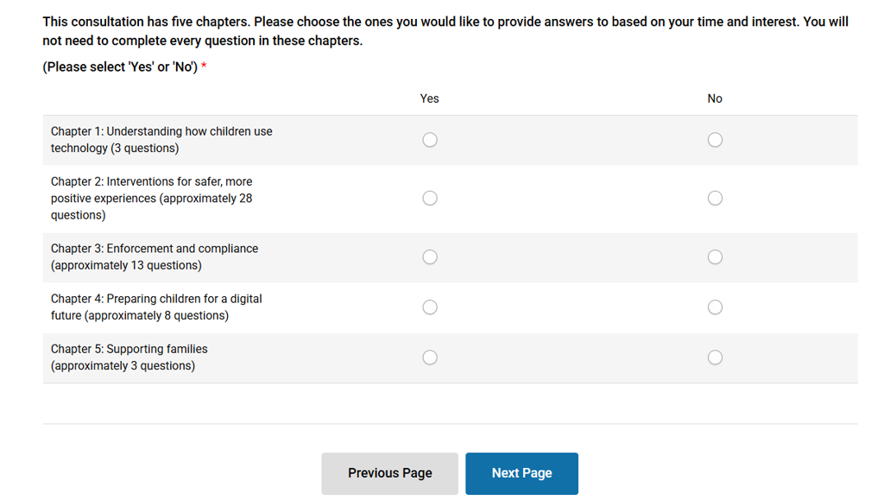
Upon engaging with the public survey, I noticed a notable disparity among its sections.
Certain parts, such as those exploring how children interact with technology, were understandably concise.
However, crucial subjects like parental controls and digital literacy appeared to be underrepresented, raising concerns about the depth of the conversation surrounding these significant issues.
The online safety survey conducted in the UK raises some significant concerns regarding privacy and digital literacy.
It comprises just six questions about digital skills, and three related to parental controls, while a staggering 38 questions focus solely on age restrictions and regulatory measures.
This imbalance suggests that decision-makers prioritize age-based safety strategies for children online, despite compelling appeals from over 400 scientists urging a pause on mandatory age verification due to associated risks.
In contrast, advocates for digital rights argue that enhancing parental controls and promoting better digital literacy offer more privacy-friendly solutions.
In addition to the number of questions, the language used in some items seems to lead participants towards a preference for stricter age restrictions on the internet.
For instance, in the parent-focused portion of the survey, when asked whether there should be a legal age requirement lower than 16 for social media platforms, respondents are not presented with a clear option to disagree.
Interestingly, the version for the general adult population provides an 'other' choice for dissenting opinions, yet parents—who are likely the most invested in participating—appear to be nudged toward supporting age-related limitations.
Moreover, the consultation invites public input on whether digital ID checks should be introduced to enforce a social media ban for minors under 16 but lacks an option for dissenting views.
The adult version does feature open-ended prompts about age restrictions which allow room for expressing worries related to privacy and freedom of expression.
However, I believe it would have benefited from straightforward queries about the potential risks posed by age verification and assurance methods.
Without direct questions, individuals may overlook the implications on their digital rights, especially those who might not grasp the technological complexities involved.
Particularly revealing is how the survey treats Virtual Private Networks (VPNs). They are commonly classified as tools to evade restrictions—a view echoed by a UK official who referred to them as a "loophole" that must be addressed.
Statements suggesting that "everyone should undergo age checks to use a VPN to hinder child access" could be interpreted as leading, potentially swaying those unfamiliar with the infrastructure of VPNs to support restrictive measures without acknowledging broader privacy ramifications.
Additionally, the parental section inquires if respondents understand their children are using VPNs to circumvent restrictions, yet it fails to offer an option for legitimate uses of VPNs, such as privacy and security.
UK Online Safety Consultation
The ongoing consultation regarding online safety in the UK has sparked a significant conversation, yet it also exposes several shortcomings.
However, it provides an important platform for public engagement on crucial changes to digital policies.
In light of potential issues, it is essential for stakeholders—including parents, teens, and privacy defenders—to participate actively.
The survey includes open-ended questions specifically about age verification and the use of VPNs, presenting a vital chance for individuals to express concerns that might not align with the multiple-choice format.
Citizens have until May 26, 2026, to share their insights and advocate for a balanced approach to securing the online experience for children while safeguarding the digital rights of all users.
Stay informed on developments by following TechRadar on Google News, and ensure you add us as a reliable source for top-notch updates, reviews, and expert opinions.
Don't forget to hit the follow button!
Why People Need VPN Services to Unblock Porn
People need VPN services to unblock porn primarily to overcome regional censorship and maintain personal privacy online, as these tools mask their location and encrypt their data. Essentially, porn unblocked refers to the ability to access adult content that is otherwise restricted in certain areas, allowing for private and unrestricted browsing.
Why Choose SafeShell VPN to Access Adult Content
If you want to access region-restricted content of Porn by Porn unblock, you may want to consider the SafeShell VPN.
The benefits are detailed as follows:
- unblock porn sites reliably with dedicated servers optimized for bypassing geo-blocks and maintaining consistent access.
- SafeShell VPN employs high-grade encryption to keep your streaming activities private and secure from any external monitoring.
- Experience minimal speed loss for smooth, buffer-free HD streaming, thanks to its optimized network infrastructure.
- Utilize multi-device support to protect all your gadgets simultaneously while accessing unblocked content.
- Benefit from user-friendly features that simplify connecting to servers ideal for adult content without technical hassle.
How to Use SafeShell VPN to Unlock Porn Sites
To begin using SafeShell VPN for accessing adult content from various regions, the first step is to subscribe to the service. Visit the official SafeShell VPN website and select a suitable subscription plan. After completing the purchase, download the SafeShell VPN application onto your preferred device, such as a smartphone or computer, and follow the installation instructions to set it up properly.
Once the application is installed, open it and navigate to the settings to enable App Mode. This feature ensures optimal performance and flexibility for streaming content. Then, proceed to the server selection menu within the SafeShell VPN interface, where you can choose from a wide range of global server locations to match the region of the content you wish to access.
After connecting to your selected server, launch your web browser or streaming app. You can now browse adult sites with enhanced privacy and unrestricted access, as SafeShell VPN encrypts your connection to protect your identity. Enjoy seamless viewing while maintaining security throughout your online session.

 Arabic
 French
 Spanish
 Portuguese
 Deutsch
 Turkish
 Dutch
Dutch
 Italiano
 Russian
 Romaian
 Portuguese (Brazil)
 Greek
Greek