
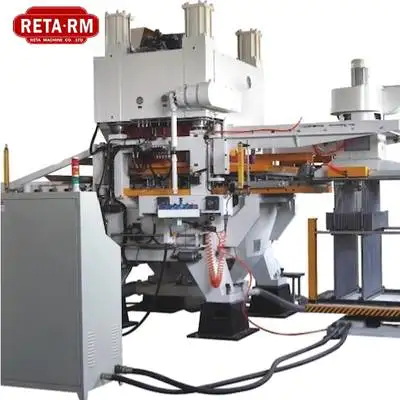
Fin press is a core specialized equipment for producing high-precision heat exchanger fins, which are widely used in HVAC, automotive, refrigeration and other industries where efficient heat transfer is critical. With the continuous upgrading of global industrial technology and the increasing demand for energy conservation and environmental protection, the manufacturing level of fin presses has achieved remarkable progress, and the stamping process has been continuously optimized to meet the diverse needs of high-efficiency, precision and large-scale production. This article focuses on the current global manufacturing level of fin presses and its core production process, presenting a comprehensive overview of this key industrial equipment.
1. Current Global Manufacturing Level of Fin Press
The manufacturing level of fin presses has formed a multi-level competitive pattern globally, with developed industrial countries such as Germany, Japan and the United States leading the way in high-end technology, while China has rapidly risen to enter the "co-running" stage and even achieved partial "leading" in some fields. The overall level is mainly reflected in four aspects: precision control, intelligent upgrading, energy efficiency optimization and structural reliability.
1.1 Precision Control Level
Precision is the core indicator of fin press manufacturing, directly determining the quality and heat transfer efficiency of fins. Currently, the advanced fin presses in the world have achieved ultra-high precision control. The positioning accuracy of the stamping process can reach ±0.005 mm, and the tolerance of fin height can be controlled within 0.05 mm, ensuring the consistency of each fin's size and shape. German equipment, represented by Schuler and TRUMPF, has outstanding advantages in long-term operation stability and material adaptability, with an average mean time between failures (MTBF) of more than 8,000 hours, which can compatible with aluminum foil of 0.08–0.3 mm and copper foil of 0.1–0.4 mm, and the scrap rate is stably controlled below 0.15%. Japanese manufacturers such as AMADA excel in precision control and energy consumption optimization; their newly launched NeoFin Pro system has a measured unit product energy consumption 18.3% lower than the industry average under the ISO 50001 energy management system certification.
Chinese fin press manufacturers have made significant breakthroughs in precision control in recent years. The third-generation intelligent production lines launched by leading enterprises such as Jingda Co., Ltd. and Keda Manufacturing have a stamping speed of 700–850 strokes per minute, and the positioning accuracy has reached the international advanced level of ±0.005 mm, approaching the level of Germany and Japan. In 2024, the domestic market share of domestic high-end production lines reached 43.7%, an increase of 21.2 percentage points compared with 2020, showing strong competitiveness in precision manufacturing.
1.2 Intelligent Upgrading Level
Intelligent transformation has become an important trend in the manufacturing of fin presses. The world's advanced fin presses have fully integrated Industry 4.0 architecture, equipped with intelligent systems such as AI visual inspection, digital twin modeling, edge computing and predictive maintenance. The AI visual inspection system can achieve a defect identification accuracy of 99.23%, effectively reducing the waste rate caused by product defects; the digital twin technology can simulate the operation state of the equipment in real time, realize the pre-judgment of faults and the optimization of process parameters, and improve the operation efficiency of the equipment.
Most domestic fin presses have adopted open control systems based on the OPC UA unified architecture, realizing seamless connection with enterprise ERP, MES and WMS systems, and realizing data-driven production management. The equipment is equipped with a touch screen control panel and a movable operating system, which is convenient for operation and parameter setting; the programmable logic controller (PLC) can automatically stop production when a predetermined number of fins are stacked, realizing automatic control of the production process. Some high-end models also have functions such as remote diagnosis and automatic die change, which greatly reduces labor intensity and equipment downtime.
1.3 Energy Efficiency and Environmental Protection Level
Against the background of global carbon neutrality, energy efficiency optimization has become a key direction for the upgrading of fin press manufacturing. The advanced fin presses in the world have adopted full servo direct drive systems and high-response hydraulic compensation devices, which have significantly reduced energy consumption while improving stamping efficiency. The unit energy consumption of the third-generation fin press is controlled at 10–13 kWh/10,000 pieces, which is much lower than 18–22 kWh/10,000 pieces of the first-generation equipment. Chinese manufacturers pay more attention to green manufacturing. The new production line in Deyang, Sichuan has reduced the carbon intensity to 0.71 kgCO₂/10,000 pieces, achieving the dual goals of energy saving and environmental protection.
1.4 Structural Reliability and Customization Level
The structural design of fin presses directly affects their service life and operation stability. High-end fin presses adopt a rigid frame structure, and extensive solid modeling is carried out in the design stage to optimize rigidity and minimize vibration during high-speed operation, ensuring stamping accuracy. For example, the FP-1400 fin press launched by Burr OAK Tool Inc. has a 160-ton (1400 kN) stamping capacity, and its dynamically balanced platform effectively reduces vibration, ensuring accuracy even at high speeds. The C-type and H-type fin press production lines launched by domestic manufacturers are equipped with hydraulic overload protection, die installation and debugging auxiliary functions, which improve the reliability and service life of the equipment.
With the diversification of downstream application needs, customization has become an important manifestation of the manufacturing level of fin presses. Manufacturers can customize equipment parameters such as material width, stack length and fin die specifications according to the specific needs of customers. For example, the material width of the CFP series fin presses can be customized up to more than 330 mm, and the stack length can be selected from 1200/1500/2000 mm; the fin die specifications cover multiple models such as φ5×19.5×11.2 and φ12.7×31.75×27.5, which can meet the production needs of different types of fins.
2. Core Manufacturing Process of Fin Press
The manufacturing process of fin press is a complex systematic project, which mainly includes four stages: material preparation, key component processing, assembly and debugging, and performance testing. Each stage has strict technical requirements to ensure the final performance and quality of the equipment.
2.1 Material Preparation
The material selection of fin press is based on the principles of high strength, wear resistance and good processing performance, which directly determines the structural stability and service life of the equipment. The main frame, slide block and workbench of the equipment are usually made of high-quality carbon structural steel or alloy steel (such as Q355B, 45# steel), which have high strength and rigidity to bear the huge pressure during stamping. The die, as the core component of stamping fins, is made of high-speed steel or cemented carbide, which has excellent wear resistance and toughness, ensuring the precision and service life of stamping dies. In addition, the metal materials used for fins are mainly aluminum foil and copper foil, which have excellent heat transfer performance and are suitable for stamping forming.
Before processing, the raw materials need to go through strict inspection, including chemical composition analysis, mechanical performance testing and surface quality inspection, to eliminate unqualified materials and lay a foundation for the subsequent processing quality. At the same time, the metal coil needs to be leveled and derusted to ensure the smoothness of the material surface and avoid affecting the stamping quality of fins.
2.2 Key Component Processing
Key components of fin press include frame, slide block, crankshaft, die system, feeding mechanism and control system, whose processing precision directly affects the overall performance of the equipment. The processing of these components adopts advanced numerical control processing technology, including CNC turning, milling, grinding, boring and other processes, to ensure the processing precision and surface quality.
The frame and workbench need to go through rough machining, semi-finish machining and finish machining. After finish machining, the flatness and parallelism of the workbench surface are controlled within 0.01 mm/m, and the surface roughness is Ra≤0.8 μm, to ensure the uniform force of the die during stamping. The crankshaft and slide block adopt precision grinding technology, and the roundness and cylindricity of the crankshaft journal are controlled within 0.005 mm, ensuring the smooth operation of the slide block and the stability of stamping speed. The die system is processed by precision EDM and wire cutting technology, and the dimensional accuracy of the die is controlled within ±0.003 mm, ensuring the precision of fin stamping and forming.
The feeding mechanism is an important part to ensure the continuous and stable operation of the fin press. The advanced feeding mechanism adopts electronic servo feeding technology, which can realize precise feeding control, with a feeding accuracy of ±0.01 mm, and can adjust the feeding speed according to the stamping speed, ensuring the synchronization of feeding and stamping. The control system adopts imported PLC and touch screen, which can realize automatic control of the whole production process, including stamping speed adjustment, fin counting, fault alarm and other functions.
2.3 Assembly and Debugging
Assembly is a key link in the manufacturing process of fin press, which requires strict assembly procedures and technical standards to ensure the coordination and stability of each component. The assembly process is carried out in the order of frame assembly, crankshaft and slide block assembly, die installation, feeding mechanism assembly and control system installation.
During assembly, the fit clearance between components is strictly controlled. For example, the fit clearance between the slide block and the guide rail is controlled between 0.01–0.02 mm, to ensure the smooth movement of the slide block and avoid deviation during stamping. The die is installed and positioned accurately, and the parallelism between the upper and lower dies is adjusted to ensure that the stamping force is uniform, avoiding the deformation of fins caused by uneven force. After assembly, the equipment is debugged, including no-load test and load test. The no-load test is used to check the operation status of each component, such as the smoothness of the slide block movement, the accuracy of the feeding mechanism and the stability of the control system; the load test is used to simulate the actual production conditions, adjust the stamping parameters, and ensure that the equipment can stably produce qualified fins under the rated load.
In addition, the equipment is equipped with a hydraulic rapid die change device, which can realize quick and convenient die change, reducing the downtime of die change and improving production efficiency. The collection device is equipped with a fault operation protection system, including no material warning and no oil warning, ensuring the safe operation of the equipment.
2.4 Performance Testing
Performance testing is the final link to ensure the quality of fin press, which mainly includes precision testing, load testing, energy consumption testing and reliability testing. The precision test mainly detects the positioning accuracy of the slide block, the parallelism of the workbench, the feeding accuracy and the dimensional accuracy of the stamped fins, ensuring that all indicators meet the design requirements. The load test detects the maximum stamping force of the equipment, the stability of the stamping speed and the deformation of the frame under the rated load, ensuring that the equipment can bear the required stamping force during actual production.
The energy consumption test detects the unit energy consumption of the equipment under different stamping speeds, ensuring that the energy efficiency meets the national and international standards. The reliability test runs the equipment continuously for a certain time (usually 1000 hours), checks the operation status of each component, records the fault situation and processing efficiency, and ensures that the equipment has good reliability and stability in long-term operation. Only after passing all performance tests can the fin press leave the factory and be put into actual production.
3. Development Trend of Fin Press Manufacturing
With the continuous development of industrial technology, the manufacturing level and process of fin presses will continue to upgrade. In the future, the development will focus on three directions: first, the further improvement of precision and speed, the stamping speed of the fourth-generation fin press is expected to exceed 1000 strokes per minute, and the positioning accuracy will be further improved to meet the needs of high-efficiency and high-precision production; second, the deep integration of intelligence and digitalization, through the application of artificial intelligence, big data and other technologies, to realize the intelligent optimization of the production process and the predictive maintenance of equipment, improving production efficiency and reducing maintenance costs; third, the continuous optimization of green manufacturing, adopting more energy-saving and environment-friendly materials and processes, reducing energy consumption and carbon emissions, and responding to the global carbon neutrality strategy.
At the same time, the standardization and internationalization of fin press manufacturing will also be further promoted. Breaking the international standard barriers such as EU DPP carbon data passport and North American UL 2900 network security certification will become an important task for manufacturers in various countries. Chinese fin press manufacturers will continue to strengthen technological innovation, improve product quality and international competitiveness, and promote the transformation from a "manufacturing highland" to a "standard source" in the global fin press industry chain.
In conclusion, the manufacturing level of fin press has achieved remarkable progress globally, showing the development characteristics of high precision, intelligence, energy saving and customization. The core manufacturing process is constantly optimized, ensuring the stability, reliability and high efficiency of the equipment. With the continuous growth of downstream market demand and the continuous advancement of technological innovation, the fin press manufacturing industry will usher in a new development opportunity, making greater contributions to the upgrading of the global heat exchange equipment industry.

 Arabic
 French
 Spanish
 Portuguese
 Deutsch
 Turkish
 Dutch
Dutch
 Italiano
 Russian
 Romaian
 Portuguese (Brazil)
 Greek
Greek