
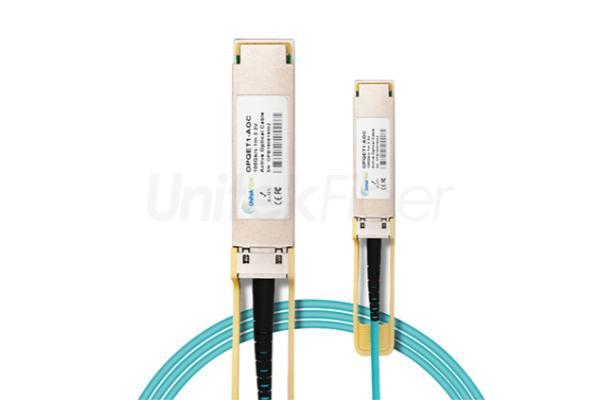
The transition from 10G and 40G to 100G networking has introduced significant challenges for physical infrastructure, particularly regarding signal loss and cable management. In high-stakes data center environments, the qsfp28 active optical cable stands out as a high-performance solution that overcomes the distance and interference limitations of traditional copper. By utilizing an integrated design that combines optical transceivers with high-speed multimode fiber, these cables provide a "plug-and-play" experience that delivers 100Gbps speeds with unparalleled reliability. This technology is essential for connecting top-of-rack switches to servers or linking switches in a spine-leaf architecture where low latency and high signal integrity are critical for operational success.
One of the most significant advantages of this optical approach is the simplicity it brings to network deployment. Because the cable and transceivers are a single, factory-tested unit, there is no need for the painstaking process of cleaning and inspecting optical connectors that modular systems require. This reduces the risk of human error during installation and ensures that the network link remains stable throughout its entire lifecycle.
The Engineering of High-Speed Signal Conversion
The performance of an active optical cable is driven by the internal electronics housed within the connector shells. These modules feature an array of vertical-cavity surface-emitting lasers (VCSELs) that convert high-speed electrical signals into light pulses. The light travels through the fiber core to the other end, where a photodiode converts it back into an electrical signal. This process happens with nearly zero latency, meeting the rigorous standards required for high-frequency trading and real-time cloud computing.
By managing the signal conversion internally, the cable can ensure that the data remains crisp and clear across distances up to 100 meters. This active signal conditioning also allows the cable to compensate for any jitter or signal distortion that might occur at the switch port level. The result is a highly robust connection that maintains a consistently low bit-error rate, providing the stable foundation needed for large-scale data processing.
Optimizing Airflow and Rack Thermal Management
In a modern data center, thermal management is a primary concern. Dense cabling can block the airflow required to keep high-performance processors cool, leading to increased power consumption and potential hardware failure. A 100g qsfp28 aoc cable offers a major physical advantage in this area due to its thin, flexible profile. These cables take up significantly less space than copper alternatives, allowing for better airflow through the server chassis and rack.
This improved form factor not only helps maintain optimal operating temperatures but also simplifies the physical organization of the rack. Technicians can route cables more easily through side channels and management arms, reducing the "cable clutter" that often complicates hardware upgrades and maintenance. A cooler, more organized rack is a more efficient rack, leading to a more sustainable and cost-effective data center operation.
Superior Resistance to Electromagnetic Interference
Data centers are filled with electrical noise generated by high-power servers, power supplies, and HVAC systems. This electromagnetic interference (EMI) can severely degrade signals traveling through copper wires, leading to data corruption and network instability. Because active optical cables use photons to transmit data, they are completely immune to EMI. This ensures that the 100G link remains stable even when routed through electrically noisy environments.
This immunity to interference is especially important in high-density environments where thousands of cables are bundled together. In such scenarios, copper cables can suffer from crosstalk, where signals from one wire leak into another. Optical fiber eliminates this risk entirely, allowing for tighter bundling and more efficient use of cable trays. This makes optical interconnects the ideal choice for massive-scale deployments where reliability cannot be compromised.
Scalability and Design Flexibility in Modern Networks
The move toward software-defined networking and virtualization requires a physical layer that is flexible and easy to scale. Utilizing a qsfp28 aoc cable provides this flexibility by offering a wide range of lengths that can accommodate various rack layouts. Whether connecting adjacent servers or linking hardware across different rows, the performance remains consistent across the entire length of the cable.
As bandwidth demands grow, the ability to quickly add high-speed links without redesigning the cooling or power infrastructure is a significant competitive advantage. The QSFP28 standard is widely supported across the industry, ensuring that these cables will remain compatible with future generations of networking hardware. This makes them a smart investment for any organization looking to build a resilient, future-proof network that can grow alongside their business.
Energy Efficiency and Long-Term Sustainability
Sustainability is no longer just a trend; it is a core business requirement for global enterprises. Reducing the energy footprint of the network is a major part of achieving corporate ESG goals. Active optical cables are designed for extreme energy efficiency, consuming significantly less power than the older generations of high-speed interconnects. This lower power draw at the port level translates into less heat and lower cooling costs for the entire facility.
By choosing energy-efficient networking components, organizations can lower their total cost of ownership while reducing their environmental impact. The long-term reliability of optical fiber also means fewer cable replacements and less electronic waste over time. In a world where every watt counts, the transition to high-performance, low-power optical interconnects is a logical step toward a more sustainable digital future.
Best Practices for Handling and Installation
To ensure the maximum lifespan of a high-speed optical network, proper handling is essential. While optical cables are durable, they should never be subjected to excessive pulling force or sharp bends that could damage the glass fiber inside. Using proper cable support structures and maintaining the minimum bend radius will ensure that the link continues to perform at its peak for years to come.
In conclusion, the integration of optical technology into the physical layer of the network has revolutionized how we think about 100G connectivity. By providing a solution that is faster, thinner, and more reliable than copper, these cables have become the backbone of modern data-driven enterprises. Whether for a small research lab or a massive cloud provider, the performance and efficiency of advanced optical assemblies ensure that data moves at the speed of light, powering the next generation of digital innovation.

 English
 Arabic
 French
 Spanish
 Deutsch
 Turkish
 Dutch
Dutch
 Italiano
 Russian
 Romaian
 Portuguese (Brazil)
 Greek
Greek