
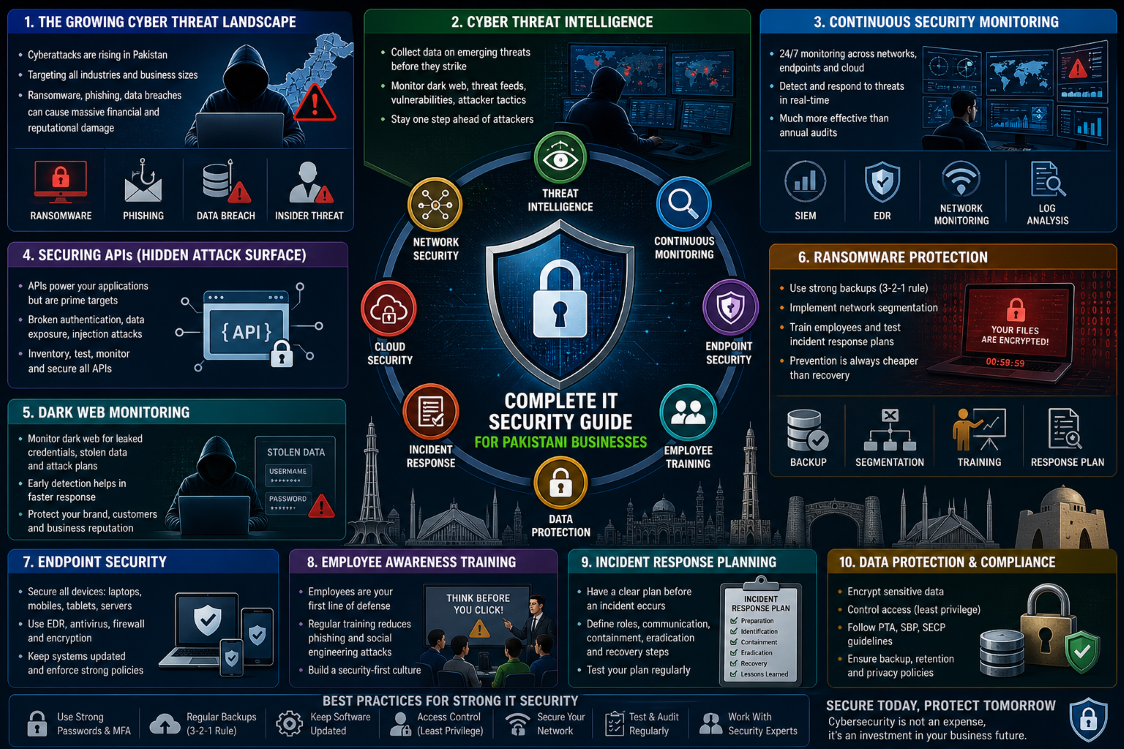
Most people imagine ethical hackers sitting in dark rooms typing furiously. The reality is far more methodical. Ethical hacking is structured problem-solving. It follows a deliberate process that mirrors real criminal attackers. Pakistani businesses that hire the best ethical hackers in Pakistan get professionals who think exactly like the criminals trying to breach them — but work entirely in their favor. Here is exactly how that thinking process works.
The Attacker Mindset: Where Everything Begins
Great ethical hackers don't think like defenders.
They think like attackers.
Defenders ask: "What have we protected?"
Attackers ask: "What can I reach that nobody thinks about?"
This perspective shift is fundamental. It reveals vulnerabilities that purely defensive thinking completely misses.
An ethical hacker looking at your login page doesn't think "this looks secure." They think "what happens if I submit 10,000 login attempts? What happens if I put special characters in the username field? What happens if I intercept this request and modify it?"
Every assumption gets challenged. Every input gets tested. Every process gets questioned.
Phase 1: Reconnaissance — Learning Everything Before Touching Anything
Professional ethical hackers spend significant time gathering information before attempting a single attack.
This phase mirrors exactly what criminal attackers do.
Passive Reconnaissance
Passive reconnaissance collects information without directly touching target systems.
Google searches reveal employee names, job titles, and technology stacks. LinkedIn profiles expose organizational structures and software platforms. DNS records reveal infrastructure details. Job postings inadvertently expose what technologies companies use internally.
Pakistani businesses are surprised how much information is publicly available about them.
Ethical hackers compile this information systematically. Every detail potentially reveals an attack vector.
Active Reconnaissance
Active reconnaissance interacts directly with target systems.
Port scanning identifies open services. Service enumeration reveals software versions. Web application crawling maps every accessible endpoint.
This phase builds a complete picture of the attack surface.
Everything gets documented. Every open port. Every running service. Every identified technology version.
Phase 2: Vulnerability Analysis — Finding the Weak Points
With a complete picture of the target environment, ethical hackers identify potential weaknesses.
This isn't just running automated scanners.
Automated tools find known vulnerabilities. Experienced ethical hackers find logic flaws automated tools never detect.
They analyze how different system components interact. They identify trust relationships between systems. They spot inconsistencies between how systems should behave and how they actually behave.
A login page that behaves slightly differently for valid versus invalid usernames. An API endpoint that returns more data than the front-end application displays. A password reset function that reveals whether email addresses exist in the system.
These subtle observations become exploitation opportunities.
Phase 3: Attack Planning — Thinking Several Steps Ahead
Before exploiting anything, great ethical hackers plan their approach completely.
They identify the most valuable targets. Customer databases. Financial records. Administrative accounts. Internal systems.
They map potential attack paths from their current position to those targets.
They prioritize paths by likelihood of success and potential impact.
This planning mirrors how sophisticated criminal attackers operate. They don't attack randomly. They plan methodically toward specific objectives.
Phase 4: Exploitation — Proving Real Impact
Exploitation is where ethical hacking differs most dramatically from vulnerability scanning.
Scanners identify potential vulnerabilities.
Ethical hackers prove whether those vulnerabilities are actually exploitable.
Single Vulnerability Exploitation
Some vulnerabilities are exploitable independently.
An unpatched server running vulnerable software. An SQL injection flaw in a login form. A misconfigured cloud storage bucket.
Ethical hackers exploit these directly. They document exactly what they accessed and what damage a real attacker could cause.
Vulnerability Chaining
This is where great ethical hackers demonstrate real expertise.
Individual vulnerabilities rated medium or low severity often seem harmless alone.
Combined creatively they become devastating.
A minor information disclosure reveals a username. A separate misconfiguration exposes a forgotten admin endpoint. A third vulnerability in that endpoint allows authentication bypass.
Three medium-severity findings individually become complete system compromise when chained intelligently.
Pakistani businesses discover through penetration testing that their most dangerous vulnerabilities were individual findings their teams already dismissed as low priority.
Phase 5: Post-Exploitation — Understanding the Full Blast Radius
Gaining initial access is just the beginning.
Professional ethical hackers then explore how far that access extends.
They attempt lateral movement across networks. They test privilege escalation opportunities. They identify what sensitive data is reachable from their compromised position.
This phase answers the question Pakistani business owners actually need answered.
"If an attacker gets this far — how much damage can they really do?"
The answer is frequently far more alarming than businesses expected.
Phase 6: Documentation — Turning Findings Into Action
Every step gets documented meticulously throughout the engagement.
Great ethical hackers document as they work. Not after.
Documentation captures exact exploitation steps. It includes screenshots proving access was gained. It records every system touched and every file accessed.
This documentation becomes the penetration test report.
What Great Reports Include
An executive summary explaining business impact in plain language.
Technical findings with complete reproduction steps. Any competent developer can reproduce and verify every finding.
Proof-of-concept evidence. Screenshots. Captured data samples showing real breach impact.
Remediation guidance. Specific fixes for every identified vulnerability. Not generic recommendations.
Risk ratings based on actual exploitability. Not just theoretical severity scores.
Pakistani businesses that receive great penetration test reports know exactly what to fix. In what order. And why each finding matters to their specific business.
The Continuous Learning Loop
Great ethical hackers never stop learning.
The threat landscape changes constantly. New attack techniques emerge weekly. New vulnerabilities appear daily.
Pakistani ethical hackers who maintain exceptional skill levels dedicate personal time to practice labs. They participate in CTF competitions. They research new attack methodologies continuously.
This ongoing learning keeps their skills current with what real attackers actually use.
Conclusion
Ethical hacking isn't random probing.
It's structured problem-solving that mirrors real criminal attack methodology.
Reconnaissance. Vulnerability analysis. Attack planning. Exploitation. Post-exploitation. Documentation.
Each phase builds on the previous. Each step brings ethical hackers closer to answering the only question that truly matters.
"Can an attacker breach us today — and how far can they go?"
Pakistani businesses that hire ethical hackers thinking this way get genuine answers. Not automated scan reports. Not theoretical risk assessments.
Real proof of what attackers can do. And exactly what to do about it.

 English
 Arabic
 French
 Spanish
 Portuguese
 Deutsch
 Turkish
 Dutch
Dutch
 Italiano
 Russian
 Portuguese (Brazil)
 Greek
Greek