
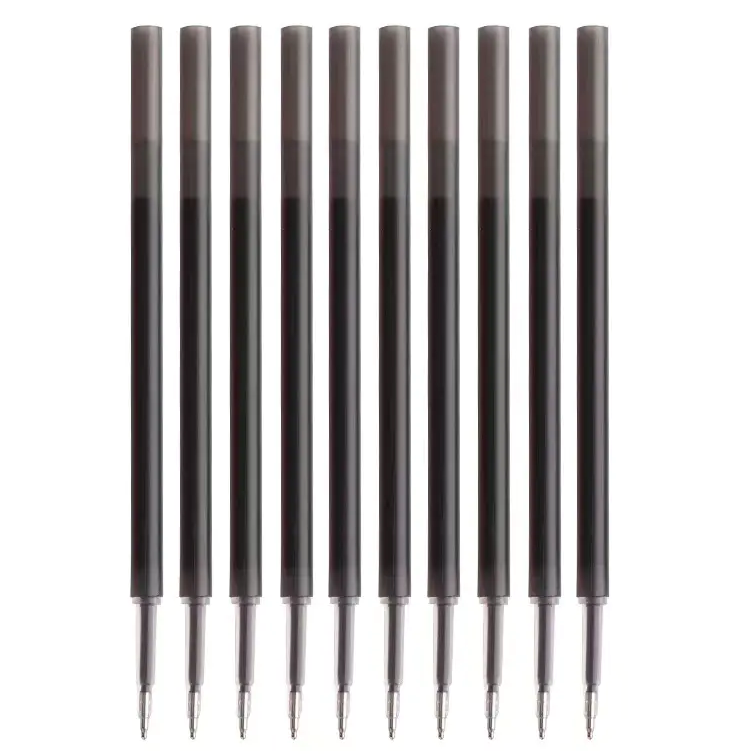
There is something quietly satisfying about pulling a gel pen across a fresh sheet of paper — the ink glides without resistance, lines appear crisp, and words seem to form almost on their own. Then one day, mid-sentence, the flow stops. The culprit is rarely the pen body itself; it is almost always the refill. Understanding what actually happens inside a gel pen refill can save you money, reduce waste, and keep your writing routine uninterrupted.
A standard gel ink refill consists of a slender ink cartridge filled with water-based gel ink, a ballpoint tip usually made from tungsten carbide or stainless steel, and a small follower plug that sits behind the ink column and prevents evaporation. The ink itself is a fascinating substance: it behaves like a thick gel at rest but thins instantly under the pressure of writing, allowing the ball to roll smoothly and deposit color on the page.
When a refill runs out prematurely, the issue often comes down to storage habits. Leaving a gel pen uncapped or storing it horizontally for extended periods can dry out the ink near the tip. Extreme temperatures — both heat and cold — can also cause the gel ink to separate or thicken beyond its working range. A good rule of thumb is to store pens upright with the tip facing down, which keeps the ink close to the ball and ready to write at a moment's notice.
Replacing a gel pen refill rather than discarding the entire pen is one of the simplest sustainable habits a writer can adopt. Many pen bodies are engineered to last years — some decades — while the cartridge inside is always the consumable part. The process is usually straightforward: unscrew or pull apart the pen barrel, slide out the spent refill, and press in a fresh one. The key is matching the refill size, typically measured by length and tip diameter in millimeters.
Gel ink comes in a remarkable range of colors, from classic black and blue to vivid metallics and translucent pastels. Tip sizes generally range from 0.3 mm for fine detail work up to 1.0 mm for bold, expressive strokes. The next time your pen falters, resist the urge to throw it away — a fresh refill is all it needs to start writing again.

 English
 Arabic
 French
 Spanish
 Portuguese
 Deutsch
 Turkish
 Italiano
 Russian
 Romaian
 Portuguese (Brazil)
 Greek
Greek